Question
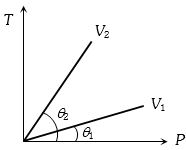
From the following $P-T$ graph what interference can be drawn
Answer

${\theta _2} > {\theta _1}$

$\Rightarrow$ $\tan {\theta _2} > \tan {\theta _1}$ 

$\Rightarrow$ ${\left( {\frac{T}{P}} \right)_2} > {\left( {\frac{T}{P}} \right)_1}$

and $PV = \mu RT$ से $\frac{T}{P} \propto V$ 

$\Rightarrow$ ${V_2} > {V_1}$

Need a full question paper?

Generate a complete, print-ready paper with questions like this in minutes — across 16+ boards, with answer keys.
Start Generating Free

Similar questions

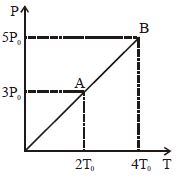
Pressure $Vs$ temperature graph of an ideal gas is shown in figure. Density of the gas at point $A$ is $\rho _0$ , Density at $B$ will be
If the breaking force for a given wire is $F$, If the thickness of the wire is doubled, then the breaking force will be
The magnetic field of a plane electromagnetic wave is given by $\overrightarrow{ B }=3 \times 10^{-8} \cos \left(1.6 \times 10^3 x +48 \times 10^{10} t \right) \hat{ j }$, then the associated electric field will be :
Two resistors are connected $(a)$ in series $(b)$ in parallel. The equivalent resistance in the two cases are $9$ $ohm$ and $2$ $ohm$ respectively. Then the resistances of the component resistors are
Heat is flowing through two cylindrical rods of the same material. The diameters of the rods are in the ratio $1 : 2$ and their lengths are in the ratio $2 : 1$. If the temperature difference between their ends is the same, then the ratio of the amounts of heat conducted through per unit time will be
Two wires of same material have length $L$ and $2L $ and cross-sectional areas $4A$ and $A$ respectively. The ratio of their specific resistance would be
The function $(sin\,\omega t -cos\,\omega t)$ represents
A small sphere of mass $m$ is dropped from a great height. After it has fallen $100\; m$ , it has attained its terminal velocity and continues to fall at that speed. The work done by air friction against the sphere during the first $ 100 \;m $ of fall is
Out of gravitational, electromagnetic, Vander Waals, electrostatic and nuclear forces; which two are able to provide an attractive force between two neutrons
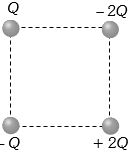
Four charges are placed on corners of a square as shown in figure having side of $5\,cm$. If $Q$ is one microcoulomb, then electric field intensity at centre will be