Question
Give any three limitations of Computer System.

Answer

Limitations of a Computer System Computer does not have intelligence of its own, it cannot think or make a decision on its own. It only runs on the instructions given to it by the humanware.
The limitations of the Computer System are:
  1. Operates on Pre-defined Instructions: A computer system carries out instructions as given in the program even if the instructions lack the quality of common sense. For example, if the instruction is given for the comparison of two unrelated amounts like sales with electricity expenses, the computer will not question the relationship like a human being but will carry out the instruction.
  2. Intelligence: A computer system does not have an intelligence of its own. It operates on the instructions which may lack this quality.
  3. Decision-Making: A computer system lacks the quality of decision-making also. Decision-making is a complex process which involves a number of elements and consideration for the prevailing situation. Programs can be designed for a computer to arrive at decisions. But such decisions will be procedural, without taking into consideration the prevailing situation.

Need a full question paper?

Generate a complete, print-ready paper with questions like this in minutes — across 16+ boards, with answer keys.

Start Generating Free

Similar questions

Define Single Entry System. What are the defects of this system?
On 1st January, 2008, A sold goods to B for ₹ 1,00,000 received ₹ 25,000 in cash and drew two bills, first ₹ 45,000 and second for ₹ 30,000 of two months each. Both bills were duly accepted by B. First bill was endorsed to C in settlement of his account of ₹ 45,000 and second bill was discounted from the bank at the rate of 12% p.a. On the due date of these bills, both bills were dishonoured, C has paid ₹ 100 and bank has paid ₹ 80 as noting charges.
Pass Journal entries in the books of A, B and C.
From the following particulars of a trader, prepare a Bank Reconcilation Statement as on 31st March, 2019.
  1. Bank overdraft as per Cash Book ₹ 52,100.
  2. During the month, the total amount of cheques for ₹ 94,400 were deposited into the bank but of these, one cheque for ₹ 11,160 has been entered into the Pass Book on 5th April.
  3. During the month, cheques for ₹ 89,580 were drawn in favour of creditors. Of them, one creditor for ₹ 38,580 encashed his cheque on 7th April whereas another for ₹ 4,320 have not yet been encashed.
  4. As per instructions the bank on 28th March paid out ₹ 10,500 to a creditor but by mistake, the same has not been entered in the Cash Book.
  5. According to agreement, on 25th March, a debtor deposited directly into the bank ₹ 9,000 but the same has not been recorded in the Cash Book.
  6. In the month of March, the bank without any intimation, debited his account for ₹ 120 as bank charges and credited the same for ₹ 180 as interest.
  7. Cash deposit of ₹ 5,780 in bank was recorded as ₹ 7,580. The error was rectified by the Bank before 31st March, 2019.
Mohan commenced business on $1^{st}$ April, $2012$ with a capital of $₹\ 50,000.$ On $1^{st}$ January, $2013,$ he introduced $₹\ 25,000$ into business of which $₹\ 10,000$ was borrowed from Ram. His position on $31^{st$} March, $2013$ was as under:
Assets: Cash in hand $₹\ 4,000;$ Bank (Cr.) $₹\ 6,500;$ Debtors $₹\ 24,000;$ B/R $₹\ 18,600.$
Stock $₹\ 25,400$; Furniture $₹\ 15,000;$ Prepaid expenses $₹\ 1,000.$
Liabilities : Creditors $₹\ 13,500;$ B/P $₹\ 4,800;$ Ram's Loan $₹\ 10,000;$ Outstanding expenses $₹\ 700.$
Actual drawings were not known but his living expenses are $₹\ 1,000$ p.m. Depreciate furniture by $10\%.$ Interest on loan is due $@ 12\%$ p.a.
Ascertain his profit or loss for the year $2012-13$ & prepare final statement of affairs.
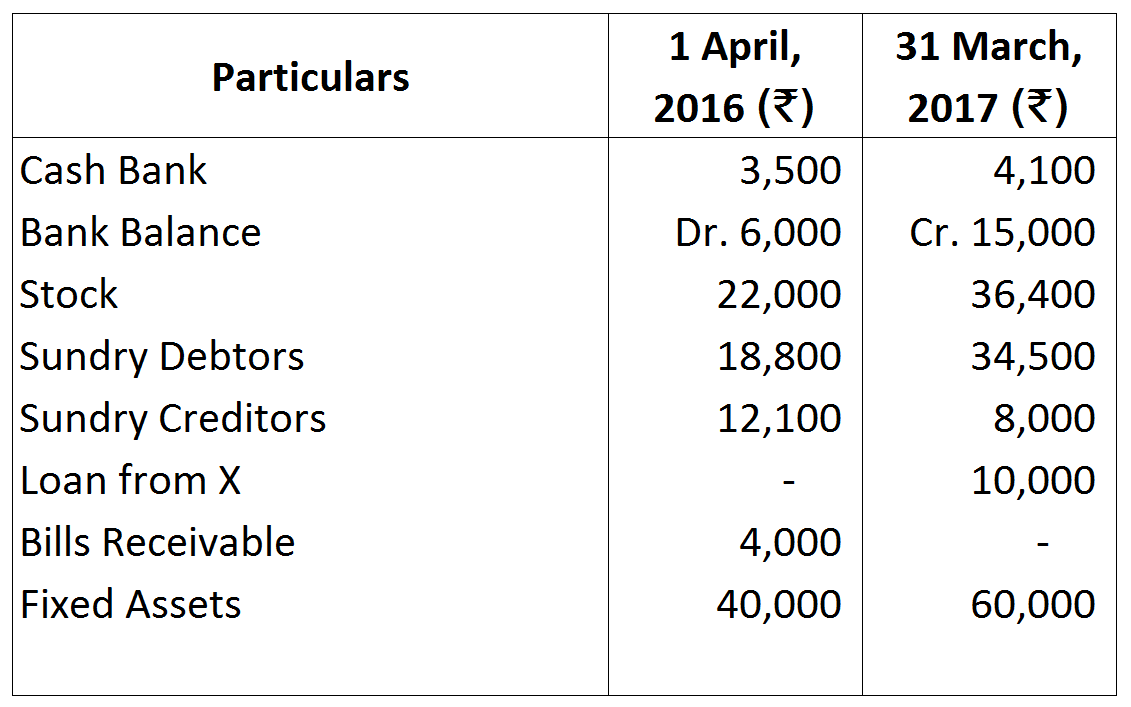
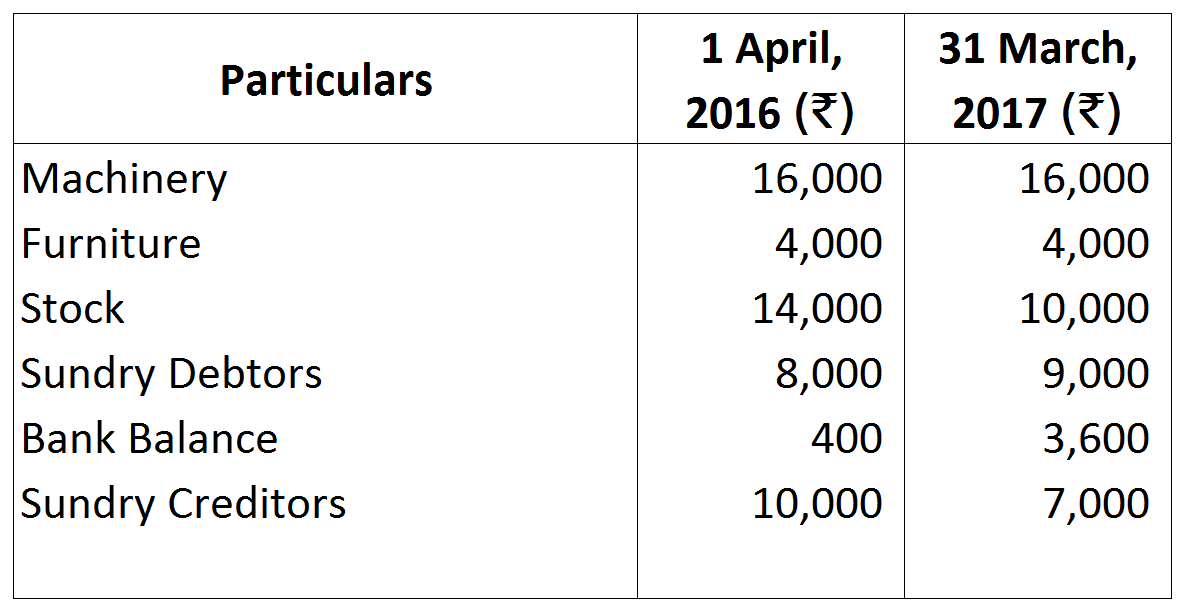
From the following information relating to the business of Mr. X who keeps books by single entry ascertain the profit or loss for the year ended $31^{st}$​​​​​​​ March,$ 2017:$
Mr. X withdrew ₹ $4,100$ during the year to meet his household expenses. He introduced ₹ $600$ as fresh capital. Machinery and furniture to be depreciated by $10\%$ and $5\%$ per annum respectively.
Roshan, whose accounts are maintained by Single Entry System, acquired a retail business on 1st April, 2017. He had ₹ 40,000 of his own and he borrowed ₹ 20,000 from his wife. He paid ₹ 15,000 for Goodwill, ₹ 5,000 for Furniture and ₹ 35,000 for Stock.
Total cash received by him during the financial year from the Debtors was ₹ 2,30,000. His payments were:
 
Purchases 1,56,000
Salary and Wages 21,400
Trade Expenses 7,200
Rent:
For business premises 5,920
For private house 2,960
Payments made for domestic purposes and drawings 26,400
At the end of the year, the Stock was ₹ 37,500. He owed ₹ 13,500 to Creditors for goods and his customers owed to him ₹ 15,000. Provide 5% for Depreciation on Furniture, Interest at 5% on wife's Loan and ₹ 1,000 for Doubtful Debts.
Prepare the Cash Account, the Profit and Loss Account for the year ended 31st March, 2018 and the Balance Sheet at the close of the year.
Give the names of different accounting packages.
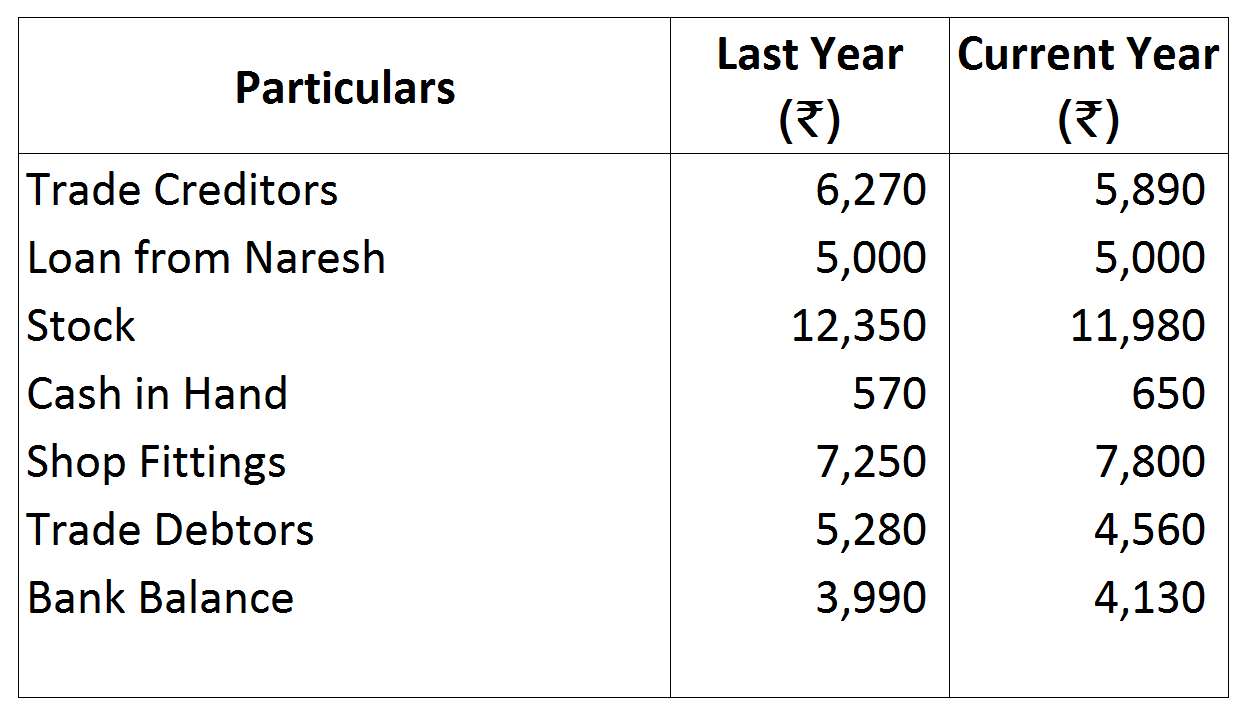
Aditya a retailer, has not maintained proper books of account but it has been possible to obtain the following details:
Calculate the net profit for this year and draft the Statement of Affairs at the end of the year after noting that:
  1. Shop Fittings are to be depreciated by ₹ 780.
  2. Aditya has drawn ₹ 100 per week for his own use.
  3. Included in the Trade Debtors is an irrecoverable balance of ₹ 270.
  4. Interest at 5% p.a. is due on the loan from Naresh but has not been paid for the year.
A retail Trader has not kept proper books of accounts. Ascertain his profit or loss for the year ending $31^{st}$ March, $2017,$ and prepare a final statement of affairs from the following information:
He withdrew from the business $₹\ 1,500$ per month for his personal use and $₹\ 8,000$ for giving a personal loan to his brother. He also used a house for his personal purposes, the rent of which at the rate of $₹\ 900$ per month and electricity charges at an average rate of $₹\ 250$ per month were paid from the business account. He had received a lottery prize of $₹\ 25,000,$ out of which he invested half the amount in business. He has not paid two months' salary to his clerk $@ ₹\ 1,200$ per month, but insurance premium $@ ₹\ 600$ per annum was paid on $1^{st}$ October, $2016$ to run for one year. Loan from $X$ was taken on $1^{st}$ July, 2016 on which interest was unpaid $@ 18\%$ p.a.
Fixed assets are to be depreciated $@ 10\%$ p.a.
What considerations should be borne in mind for Designing Accounting Reports.