Question
  1. Give reasons for the following:
i. $Mn ^{3+}$ is a good oxidizing agent.
ii. $E ^{\circ} m ^{2+} / M$ values are not regular for first row transition metals. (3d series)
iii. Although ' $F$ ' is more electronegative then ' O ', the highest Mn fluoride is $Mnf _4$, whereas the highest oxide is $Mn _2 O _7$.
  1. Complete the following equations:
$\text{2CrO}_{4}^{2}+\text{2H}^{+}\rightarrow$

$\text{KMnO}_{4}\xrightarrow{heat}$

Answer

  1.  
i. $Mn ^{3+}\left(3 d^4\right)$ good electron acceptor as resulting species is more stable $\left(3 d^5\right)$
ii. The $E^{\circ}\left( M ^{2+} / M \right)$ values are not regular which can be explained from the irregular variation of ionisation enthalpies $\left(\Delta iH _1+\Delta i H _2\right)$, sublimation enthalpies and hydration enthalpies.
iii. Due to multiple bond formation ability of oxygen with Mn in $Mn _2 O _7$.
  1.  
  1. $2CrO_4^{2-} + 2H^+ \rightarrow Cr_2O_7^{2-}+ H_2O.$
  2. $2KMnO_4$​​​​​​​ $\xrightarrow{Heat} K_2MnO_4 + MnO_2 + O_2.$

Need a full question paper?

Generate a complete, print-ready paper with questions like this in minutes — across 16+ boards, with answer keys.

Start Generating Free

Similar questions

  1. A $10\%$ solution (by mass) of sucrose in water has a freezing point of $269.15 K$. Calculate the freezing point of $10\%$ glucose in water if the freezing point of pure water is $273.15 K$. Given:
(Molar mass of sucrose = $342 g mol^{-1}$)

(Molar mass of glucose = $180 g mol^{-1}$)
  1. Define the following terms:
  1. Molality (m)
  2. Abnormal molar mass
Explain the following :
(i) Fermentation
(ii) Dehydration
(iii) Hydrogen bonding in alcohols.
i. Name the element of 3d transition series which shows maximum number of oxidation states. Why does it show so?
ii. which transition metal of 3 d series has positive $E ^{\circ}\left( M ^{2+} / M \right)$ value and why?
iii. Out of $Cr ^{3+}$ and $Mn ^{3+}$, which is a stronger oxidizing agent and why?
iv. Name a member of the lanthanoid series which is well known to exhibit +2 oxidation state.
v. Complete the following equation:
$MnO_4^{-}+8 H^{+}+5 e^{-} \rightarrow$

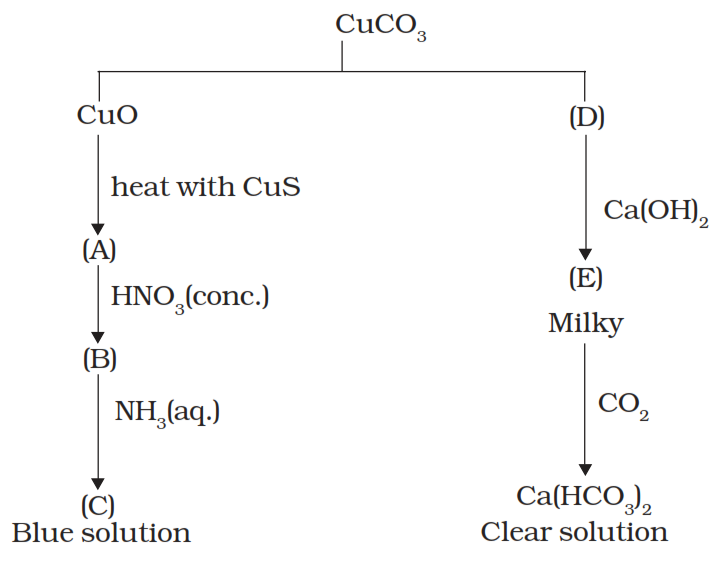
Identify $A$ to $E$ and also explain the reactions involved.
$[A], [B], [C], [D], [E], [F]$ and $[G]$ are amines each of which forms a hydrochloride containing $32.42\%$ chlorine. $[A], [B], [C]$ and $[D]$ evolve $N_2$ on reaction with $HNO_2,$ but $[E], [F], [G]$ and $[H]$ do not. Give structures of $[A]$ to $[H]$ with reasons.
Write the $S _{ N } 2$ mechanism of bimolecular nucleophilic substitution.
What is the role of adsorption in heterogenous catalysis?
Discuss aldol condensation in detail.
Image
What is crystal field splitting energy? How does the magnitude of $\Delta_0$ decide the actual configuration of d-orbitals in a coordination entity?