Question
Give the technical terms for the following:
  1. Molecular Scissors.
  2. Molecular Sieve.
  3. Molecular Glue.
  4. Autonomous replicating circular DNA.
  5. First isolated restriction endonuclease.
  6. Extraction of DNA fragments from gel.
Answer

  1. Restriction endonucleases.
  2. Agarose gel.
  3. DNA - ligase.
  4. Plasmid.
  5. Hind II.
  6. Elution.

Need a full question paper?

Generate a complete, print-ready paper with questions like this in minutes — across 16+ boards, with answer keys.

Start Generating Free

Similar questions

A.
(i) Why is there a need to conserve biodiversity? (Any two reasons)
(ii) Name and explain any two causes that are responsible for the loss of biodiversity.
Define decomposition and describe the processes and products of decomposition.
State the modifications of forelimb in animals as an example of homology.
Observe the representation of genes involved in the lac operon given below.

  1. Identify the region where the repressor protein will attach normally.
  2. Under certain conditions repressor is unable to attach at this site. Explain.
  3. If repressor fails to attach to the said site what products will be formed by z, y and a?
  4. Analyse why this kind of regulation is called negative regulation.
Using a flow chart explain the process of decomposition. List the factors which affect this process.
List the harmful effects caused by alcohol/ drug abuse.
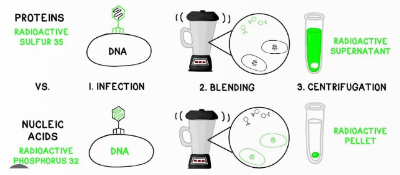
In 1952, Alfred Hershey and Martha Chase took an effort to find the genetic material in organisms. Their experiments led to an unequivocal proof to DNA as genetic material.
Image

Answer the following questions based on Hershey and Chases's experiments:
i. Name the kind of virus they worked with and why?
ii. Why did they use two types of culture media to grow viruses in? Explain.
iii. What was the need for using a blender and later a centrifuge during their experiments? OR
iv. State the conclusion drawn by them after the experiments.
With a neat, labelled diagram, describe the parts of a typical angiosperm ovule.
Define aneuploidy. How is it different from polyploidy? Describe the individuals having following chromosomal abnormalities.
  1. Trisomy of 21st Chromosome.
  2. XXY.
  3. XO.
List the components of the embryo sac and mention their fate on fertilisation.

OR

Mention the fate of all the components of the embryo sac after fertilisation.
