Question
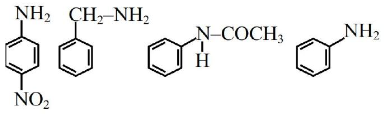
Given below are some nitrogen containing compounds.
Image
Each of them is treated with HCl separately. 1.0 g of the most basic compound will consume _____________ mg of HCl .
(Given molar mass in $\mathrm{g} \mathrm{mol}^{-1} \mathrm{C}: 12, \mathrm{H}: 1, \mathrm{O}: 16$, $\mathrm{Cl}: 35.5)$
Answer

(341)
Sol.
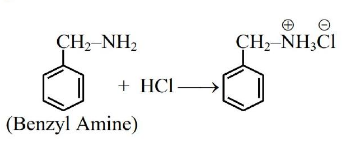
Benzyl Amine is most basic due to localised lone pair.
Image
Mole of benzyl Amine $\Rightarrow \frac{1}{107}=0.00934$ mole
1 Mole of Benzyl amine consumed 1 mole of HCl
So, Mole of HCl consumed $\rightarrow 0.00934$ mole
Mass of HCl consumed $\rightarrow 0.00934 \times$ molar mass of HCl
$
\begin{aligned}
& =0.00934 \times 36.5 \\
& =0.341 \mathrm{gm} \\
& =341 \mathrm{mg}
\end{aligned}
$

Need a full question paper?

Generate a complete, print-ready paper with questions like this in minutes — across 16+ boards, with answer keys.

Start Generating Free

Similar questions

After how many seconds will the concentration of the reactants in a first order reaction be halved, if the decay constant is ${\rm{1}}{\rm{.155}} \times {\rm{1}}{{\rm{0}}^{{\rm{ - 3}}}}\,{\sec ^{ - 1}}$ ........... $\sec$
Amongst $BeF _{2}, BF _{3}, H _{2} O , NH _{3}, CCl _{4}$ and $HCl$, the number of molecules with non-zero net dipole moment is ...... .
$56.0\,L$ of nitrogen gas is mixed with excess of hydrogen gas and it is found that $20\,L$ of ammonia gas is produced. The volume of unused nitrogen gas is found to be $L$.
Calculate enantiomeric excees of mixture containing $6g$ of $( +) - 2$ -butanol and  $4g$ of $(-) - 2$ -butanol........$\%$
Consider the two different first order reactions given below

$\mathrm{A}+\mathrm{B} \rightarrow \mathrm{C}$ (Reaction 1$)$

$\mathrm{P} \rightarrow \mathrm{Q}$ (Reaction $2$)

The ratio of the half life of Reaction $1$ : Reaction $2$ is $5: 2$. If $t_1$ and $t_2$ represent the time taken to complete $2 / 3^{\text {dd }}$ and $4 / 5^{\text {dd }}$ of Reaction $1$ and

Reaction $2$, respectively, then the value of the ratio $\mathrm{t}_1: \mathrm{t}_2$ is . . . .$\times 10^{-1}$ (nearest integer).

[Given: $\log _{10}(3)=0.477$ and $\log _{10}(5)=0.699$ ]

$\mathrm{A}(\mathrm{s}) \rightleftharpoons \mathrm{M}(\mathrm{s})+\frac{1}{2} \mathrm{O}_{2}(\mathrm{~g})$

The equilibrium constant for the reaction is $K_{p}=4$, At equilibrium, the partial pressure of $\mathrm{O}_{2}$ is $....\,atm.$ (Round off to the nearest integer).

Number of optical isomers possible for $2$ - chlorobutane..........
Maltose contains how many oxygen atoms
$0.16\, g$ of dibasic acid required $25 \,ml$ of decinormal $NaOH$ solution for complete neutralisation. The molecular weight of the acid will be
The rate of certain reaction depends on concentration according to the equation $\frac{{ - dc}}{{dt}}\, = \,\frac{{{K_1}C}}{{1 + {K_2}C}},$ what is the order, when concentration $(c)$ is very-very high