Question
Given below are two statements: One is labelled as Assertion $(A)$ and the other is labelled as Reason $(R).$

Assertion $(A)$ : In an uniform magnetic field, speed and energy remains the same for a moving charged particle.

Reason $(R)$ : Moving charged particle experiences magnetic force perpendicular to its direction of motion.
Answer

$\overrightarrow{ F }= q (\overrightarrow{ v } \times \overrightarrow{ B })$

$\overrightarrow{ F } \perp \overrightarrow{ V }$

Work done $=\overrightarrow{ F } \cdot \overrightarrow{ S }$

Work done $=0$

Need a full question paper?

Generate a complete, print-ready paper with questions like this in minutes — across 16+ boards, with answer keys.

Start Generating Free

Similar questions

A wire length $2\,m$ carrying a current of $1\,A$ is bent to form a circle. The magnetic moment of the coil is
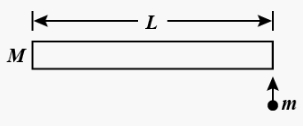
A stick of length $l$ and mass $M$ lies on a frictionless horizontal surface on which it is free to move in any way. A ball of mass $m$ moving with speed $v$ collides elastically with the stick as shown in the figure. If after the collision ball comes to rest, then what should be the mass of the ball
There are $0.8 \times 10^{23}$ free electrons $/ cm^3$ in copper. If $0.2\, A $ current is  flowing is copper wire, then the drift velocity of electrons will be, if the cross sectional area  of wire is $0.01 \,cm^2$
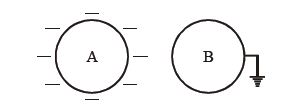
Two concentric spheres $A$ and $B$ are kept very near to each other. $A$ is negatively charged and $B$ is earthed. The true statement is

$(A)$ Charge on $B$ is zero

$(B)$ Potential at $B$ is zero

$(C)$ Charge is uniformly distributed on $A$

$(D)$ Charge is non uniformly distributed on $A$

A solenoid is at potential difference $60\, V$ and current flows through it is $15$ ampere, then the resistance of coil will be ............ $\Omega$
$A$ man of mass $M$ stands at one end of a plank of length $L$ which lies at rest on a frictionless surface. The man walks to other end of the plank. If the mass of the plank is $\frac{M}{3}$ , then the distance that the man moves  relative to ground is :
The radius in kilometer to which the present radius of earth $( R =6400\, km )$ to be compressed so that the escape velocity is increased $10$ time is ............$km$
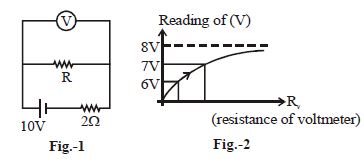
In the given figure $-1$, resistance of shown voltmeter is variable. Variation of whose reading with respect to its resistance is shown in figure $-2$. The value of $R$ is ............... $\Omega$
A ball of mass $1\, g$ and charge ${10^{ - 8}}\,C$ moves from a point $A$. where potential is $600\, volt$ to the point $B$ where potential is zero. Velocity of the ball at the point $B$ is $20\, cm/s$. The velocity of the ball at the point $A$ will be
Which of the following has the most acidic hydrogen