Question
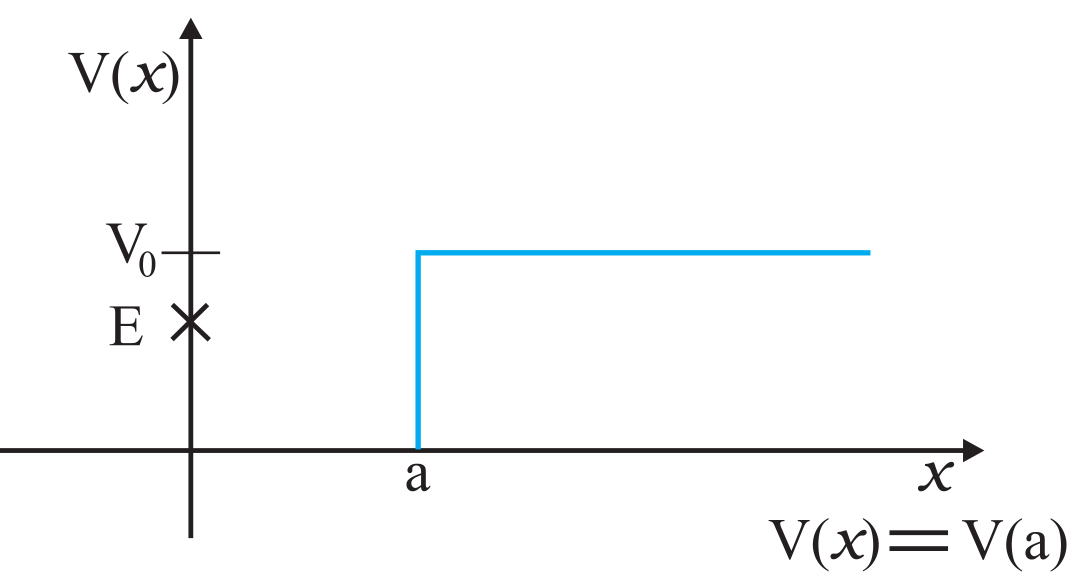
Given in are examples of some potential energy functions in one dimension. The total energy of the particle is indicated by a cross on the ordinate axis. In each case, specify the regions, if any, in which the particle cannot be found for the given energy. Also, indicate the minimum total energy the particle must have in each case. Think of simple physical contexts for which these potential energy shapes are relevan.
Answer

Total energy of a system is given by the relation, E = P.E. + K. E.
$\therefore$ K.E. = E - P.E. Kinetic energy of a body is a positive quantity. It cannot be negative. Therefore, the particle will not exist in a region where K.E. becomes negative. For $\mathrm{x}>$ a, P.E. $\left(V_0\right)>E $
$\therefore$ K.E. becomes negative. Hence the object cannot be present in the region $\mathrm{x}<\mathrm{a}$ and $\mathrm{x}>\mathrm{b} . \mathrm{x}>\mathrm{a}$ and $\mathrm{x}<\mathrm{b}$; $-\mathrm{V}_1$ In the given case, the condition regarding the positivity of K.E. is satisfied only in the region between $\mathrm{x}>\mathrm{a}$ and $\mathrm{x}<\mathrm{b}$. The minimum potential energy in this case is $-\mathrm{V}_1$. Therfore, $\mathrm{K} \cdot \mathrm{E} .=\mathrm{E}-\left(-\mathrm{V}_1\right)=\mathrm{E}+\mathrm{V}_1$.
Therefore, for the positivity of the kinetic energy, the total energy of the particle must be greater than $-\mathrm{V}_1$.
So, the minimum total energy the particle must have is $-\mathrm{V}_1 \cdot \frac{\mathrm{~b}}{2}<\mathrm{x}<\frac{\mathrm{a}}{2} ; \frac{\mathrm{a}}{2}<\mathrm{x}<\frac{\mathrm{b}}{2} ;-\mathrm{V}_1$ In the given case, the potential energy $\left(\mathrm{V}_0\right)$ of the particle becomes greater than the total energy ( E ) for $\frac{\mathrm{b}}{2}<\mathrm{x}<\frac{\mathrm{b}}{2}$ and $-\frac{\mathrm{a}}{2}<\mathrm{x}<\frac{\mathrm{a}}{2}$.
Therefore, the particle will not exist in these regions. The minimum potential energy in this case is $-\mathrm{V}_1$. Therfore, K.E. $=\mathrm{E}-\left(-\mathrm{V}_1\right)$ $=\mathrm{E}+\mathrm{V}_1$. Therefore, for the positivity of the kinetic energy, the totaol energy of the particle must be greater than $-\mathrm{V}_1$. So, the minimum total energy the particle must have is $-\mathrm{V}_1$.

Need a full question paper?

Generate a complete, print-ready paper with questions like this in minutes — across 16+ boards, with answer keys.

Start Generating Free

Similar questions

Prove that the path of one projectile as seen from another projectile is a straight line.
The displacement of two particles executing simple harmonic motion are represented by equations, $\text{y}=4\sin(10\text{t}+\theta)$ and $\text{y}=5\cos10\text{t}$ What is the phase difference between the velocities of these particles?
Ten one-rupee coins are put on top of each other on a table. Each coin has a mass m. Give the magnitude and direction of:
  1. The force on the $7^{th}$ coin (counted from the bottom) due to all the coins on its top.
  2. The force on the $7^{th}$ coin by the eighth coin.
  3. The reaction of the 6th coin on the $7^{th}$ coin.
Find the increase in surface energy when a large drop of water is sprayed into small droplets.
Obtain an expression for linear acceleration of a cylinder rolling down an inclined plane and hence find the condition for the cylinder to roll down the inclined plane without slipping.
Two billiard balls each of mass $0.05kg$ moving in opposite directions with speed $6ms^{-1}$ collide and rebound with the same speed. What is the impulse imparted to each ball due to the other?
Suppose a tunnel is dug through the earth from one side to the other side along a diameter. Show that the motion of a particle dropped into the tunnel is simple harmonic motion. Find the time period. Neglect all the frictional forces and assume that the earth has a uniform density.
$G = 6.67 \times 10^{-11}Nm^2kg^{-2};$ density of earth = $5.51 \times 10^3kg m^{-3}$
The two blocks in an Atwood machine have masses $2.0kg$ and $3.0kg$. Find the work done by gravity during the fourth second after the system is released from rest.
Solve the previous problem if the coefficient of restitution is e. Use $\theta=45^\circ,\ \text{e}=\frac{3}{4}$ and h = 5m
In a Young's double slit experiment using monochromatic light, the fringe pattern shifts by a certain distance on the screen when a mica sheet of refractive index $1.6$ and thickness $1.964$ micron ($1\ micron = 10^{-6}m$) is introduced in the path of one of the interfering waves. The mica sheet is then removed and the distance between the screen and the slits is doubled. It is found that the distance between the successive maxima now is the same as the observed fringe-shift upon the introduction of the mica sheet. Calculate the wavelength of the monochromatic light used in the experiment.