Question
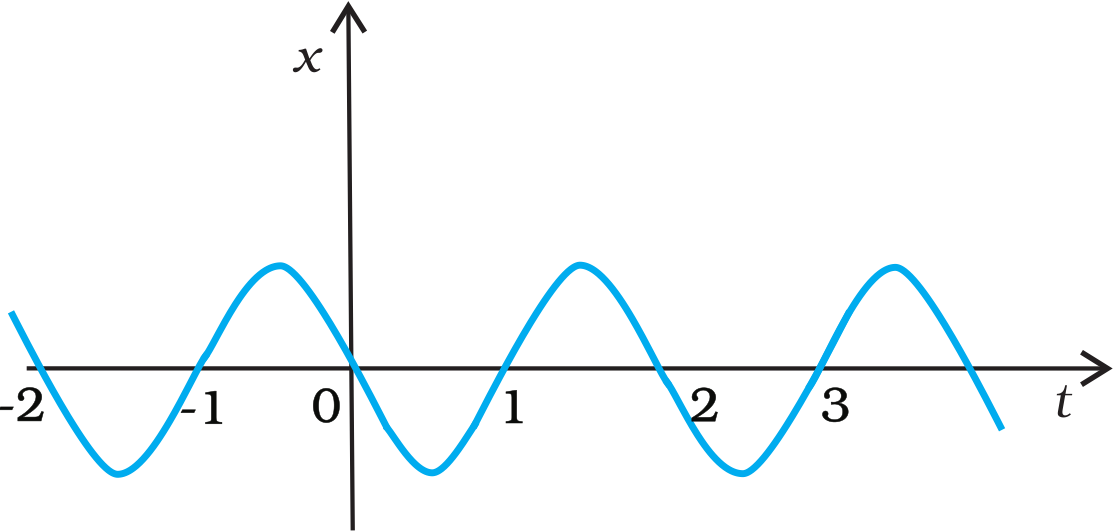
Gives the x-t plot of a particle executing one-dimensional simple harmonic motion. (You will learn about this motion in more detail in Chapter 14). Give the signs of position, velocity and acceleration variables of the particle at t = 0.3 s, 1.2 s, – 1.2 s.
Answer

For simple harmonic motion (SHM) of a particle, acceleration (a) is given by the relation: $\text{a}=-\omega^2\text{x}$ Where $\omega$ = angular frequency t = 0.3s In this time interval, x is negative. Now the slope of the x-t plot is negative. Therefore, both position and velocity are negative. Acceleration of the particle using (i) will be positive. t = 1.2s In this time interval, x is positive. Now the slope of the x-t plot is positive. Therefore, both position and velocity are positive. Acceleration of the particle using (i) will be negative. t = – 1.2s In this time interval, x is negative. Now the slope of the x-t plot is positive. Therefore, position is negative and velocity is positive. Acceleration of the particle using (i) will be positive.

Need a full question paper?

Generate a complete, print-ready paper with questions like this in minutes — across 16+ boards, with answer keys.

Start Generating Free

Similar questions

During summers in India, one of the common practice to keep cool is to make ice balls of crushed ice, dip it in flavoured sugar syrup and sip it. For this a stick is inserted into crushed ice and is squeezed in the palm to make it into the ball. Equivalently in winter, in those areas where it snows, people make snow balls and throw around. Explain the formation of ball out of crushed ice or snow in the light of P–T diagram of water.
Describe the application of the first law of thermodynamics.
$36$. You are given, the following data about a group of particles, where n represents the number of molecules with speed $v_i$
$n_i$
2
4
8
6
3
$v_i(ms^{-1})$
1.0
2.0
3.0
4.0
5.0
Calculate:
  1. Average speed.
  2. Rms speed.
  3. Most probable speed.
A circular loop of string rotates about its axis on a frictionless horizontal plane at a uniform rate so that the tangential speed of any particle of the string is v. If a small transverse disturbance is produced at. a point of the loop, with what speed (relative to the string) will this disturbance travel on the string?
Two convex lenses, each of focal length $10cm$, are placed at a separation of $15cm$ with their principal axes coinciding,
  1. Show that a light beam coming parallel to the principal axis diverges as it comes out of the lens system.
  2. Find the location of the virtual image formed by the lens system of an object placed far away.
  3. Find the focal length of the equivalent lens.
(Note that the sign of the focal length is positive although the lens system actually diverges a parallel beam incident on it).
Figure shows a square frame of wire having a total resistance r placed coplanarly with a long, straight wire. The wire carries a current i given by $\text{i}=\text{i}_0\sin\omega\text{t}.$ Find
  1. The flux of the magnetic field through the square frame.
  2. The emf induced in the frame.
  3. The heat developed in the frame in the time interval 0 to $\frac{20\pi}{\omega}.$
Derive an expression for velocity of a car on a banked circular road having coefficient of friction $\mu$ and $\text{v}>\text{v}_0.$ Write the expression for optimum velocity of the car. (v: speed of car, $v_o$: optimum speed)
For the wave described in Exercise 15.8, plot the displacement (y) versus (t) graphs for x = 0, 2 and 4cm. What are the shapes of these graphs? In which aspects does the oscillatory motion in travelling wave differ from one point to another: amplitude, frequency or phase?
An LR circuit having a time constant of 50ms is connected with an ideal battery of emf $\in.$ Find the time elapsed before:
  1. The current reaches half its maximum value.
  2. The power dissipated in heat reaches half its maximum value.
  3. The magnetic field energy stored in the circuit reaches half its maximum value.
A hole of radius $r_1$ is made centrally in a uniform circular disc of thickness d and radius $r_2$. The inner surface (a cylinder of length d and radius $r_1​​​​​​​$) is maintained at a temperature $\theta_1$ and the outer surface (a cylinder of length d and radius $r_2$) is maintained at a temperature $\theta_2(\theta_1>\theta_2).$ The thermal conductivity of the material of the disc is K. Calculate the heat flowing per unit time through the disc.