Question
Heat is transferred from inside a refrigerator at 287 K to a room at 310 K ideally, how much heat (in joules) will be given to the room by the expenditure of each joule of electrical energy?

Answer

Given that :
$\begin{aligned}T_2 & =287 K \\T_1 & =310 K \\Q_1 & =? \\W & =1 J\end{aligned}$
$\begin{array}{l}\text {Using the relation :}\quad\alpha=\frac{T_2}{T_1-T_2} \\\alpha=\frac{287}{310-287}=\frac{287}{23} \\\text {We get}\quad\quad\alpha=12.48\end{array}$
$\begin{array}{l}\text {We also know that}\quad\alpha=\frac{Q_2}{W}=\frac{Q_2}{1} \\\alpha=Q_2\end{array}$
$\therefore \quad Q_2=12.48 J$
$\text {$\therefore$ Now}\quad W=Q_1-Q_2$
$\text {or}\quad Q_1=W+Q_2$
Total heat supplied to the room :
$\begin{array}{l}Q_1=1+12.48 \\Q_1=13.48 J\end{array}$

Need a full question paper?

Generate a complete, print-ready paper with questions like this in minutes — across 16+ boards, with answer keys.
Start Generating Free

Similar questions

The cross-sectional areas of two rods made of the same metal are equal. The length of one rod is 40 cm and the temperature difference at its ends is $120^{\circ}\text C $ and the length of the other rod is 60 cm and the temperature difference at its ends is $120^{\circ}\text C $. Give the necessary calculations and tell which rod will have the higher rate of heat conduction?
What is elastic hysteresis?
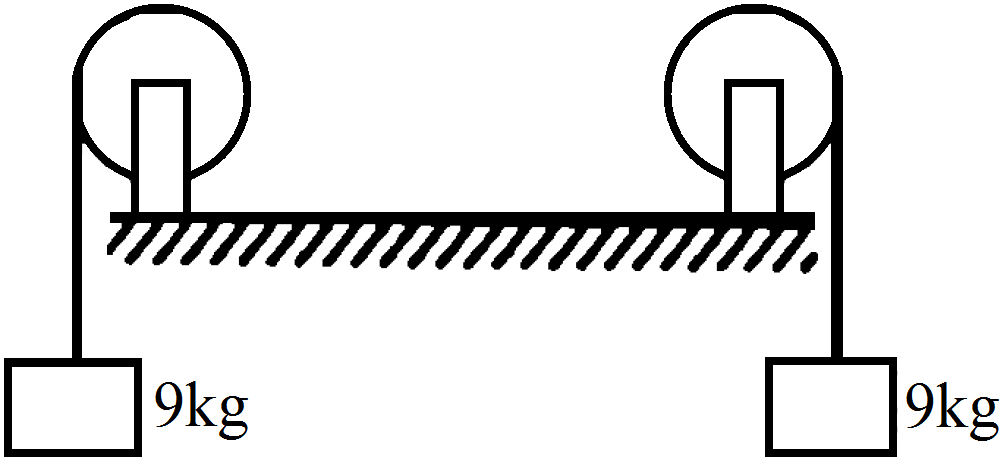
The length of the wire shown in figure, between the pulleys is 1.5m and its mass is 12.0g. Find the frequency of vibration with which the wire vibrates in two loops leaving the middle point of the wire between the pulleys at rest.
When a bus decends a hilly road at a constant speed, the brake drums become hot, why?
Two spherical balls of mass 10kg each are placed 10cm apart. Find the gravitational force of attraction between them.
For the determination of ‘g’ using a simple pendulum, measurements of I and T are required. Error in the measurement of which of these will have larger effect on the value of 'g' thus obtained and why? What is done to minimize this error?
A convex lens of diameter 8.0cm is used to focus a parallel beam of light of wavelength 620nm. If the light be focused at a distance of 20cm from the lens, what would be the radius of the central bright spot formed?
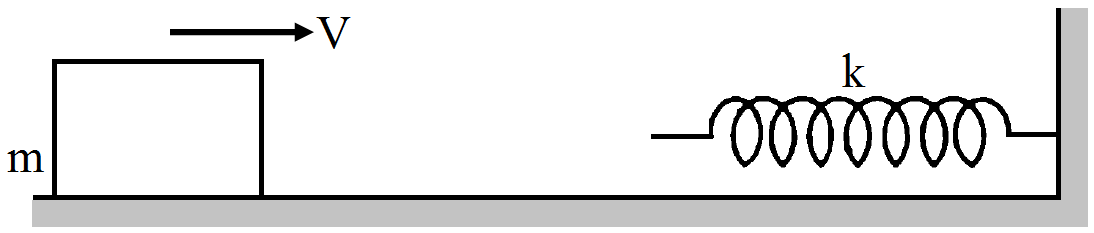
A block of massip, sliding on a smooth horizontal surface with a velocity $\vec{\text{v}}$ meets a long horizontal spring fixed at one end and having spring constant k as shown in figure. Find the maximum compression of tin spring. Will the velocity of the block be the same $\vec{\text{v}}$ when it comes back to the original position shown?
If $\text{y}=\frac{1}{\sqrt{\text{a}}}\sin\omega\text{t}-\frac{1}{\sqrt{\text{b}}}\cos\omega\text{t},$ find the amplitude of motion.
The distance travelled by a body is proportional to the square of time. What type of motion this body has?