MCQ
Holes are created when:
  • A
    Electric discharge causes damage to semicondcutors.
  • B
    There are too many electrons.
  • A co$-$valent bond is broken due to thermal energy, the removal of one electron leaves a vacancy.
  • D
    None of these

Answer

Correct option: C.
A co$-$valent bond is broken due to thermal energy, the removal of one electron leaves a vacancy.

Holes are created when a co$-$valent bond is broken due to thermal energy. The removal of one electron leaves a vacancy known as a hole.

Need a full question paper?

Generate a complete, print-ready paper with questions like this in minutes — across 16+ boards, with answer keys.
Start Generating Free

Similar questions

How does the potential difference change with the effect of the dielectric when the battery remains connected across the capacitor?
A point charge $+q,$ is placed at a distance d from an isolated conducting plane. The field at a point $P$ on the other side of the plane is:
If a radioactive substance reduces to $\frac {1}{16}$ of its original mass in 40 days, what is its half-life
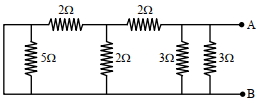
The equivalent resistance of the given circuit between the terminals ${A}$ and ${B}$ is  $....\Omega$
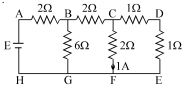
The figure shows a network of resistors and $a$ battery. If $1\,A$ current flowsthrough the branch $CF$, then answer the following questions The $\mathrm{emf}$ $E$ of the battery is If a zero resistance wire is connected in parallel to branch $CF$ ............... $V$
Antinodal curves correspond to $........$ interference.
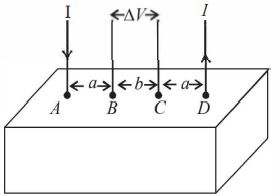
Consider a block of conducting material ofresistivity '$\rho$' shown in the figure. Current '$I$' enters at '$A$' and leaves from '$D$'. We apply superp osition principle to find voltage '$\Delta  V$ ' developed between '$B$' and '$C$'. The calculation is done in the following steps:
$(i)$ Take current '$I$' entering from '$A$' and assume it to spread over a hemispherical surface in the block.
$(ii)$ Calculatefield $E(r)$ at distance '$r$' from $A$ by using Ohm's law $E = \rho  j$, where j is the current per unit area at '$r$'.
(iii) From the '$r$' dependence of $E(r)$, obtain the potential $V(r)$ at $r$.
(iv) Repeat $(i), (ii)$ and $(iii)$ for current '$I$' leaving '$D$' and superpose results for '$A$' and '$D$'.

$\Delta V$ measured between $B$ and $C$ is
A potentiometer consists of a wire of length 4 m and resistance 10 W. It is connected to cell of emf 2 V. The potential difference per unit length of the wire will be
In a series $\text{LCR}$ circuit, the voltage across the resistance, capacitance and inductance is $10 V$ each. If the capacitance is short circuited the voltage across the inductance will be
The curvature radii of a concavo-convex glass lens are $20\, cm$ and $60\, cm$. The convex surface of the lens is silvered. With the lens horizontal, the concave surface is filled with water. The focal length of the effective mirror is $(\mu$ of glass $= 1.5$, $\mu$ of water $= 4/3)$