Question
How can you find the following?
1. Velocity from a displacement - time graph.
2. Acceleration from velocity - time graph.
3. Displacement from velocity - time graph.
4. Velocity from acceleration - time graph.
Answer

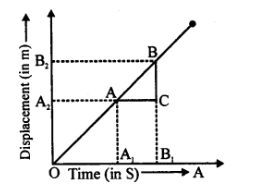
(i) Velocity from a displacement - time graph : Displacement time graph for uniform motion is a straight line (OP) inclined to time axis. Take any two points $A$ and $B$ on this graph OP. From $A$ and $B$, draw perpendiculars on time axis as well as displacement axis. So, by knowing the slope of displacement - time graph. We can find the velocity of the body.
Image
Such that,
$OA_1=t_1, OB_1=t_2, OA_2=x_1 \text { and } OB_2=x_2$
Slope of displacement - time graph $=\frac{ BC }{ AC }$
$=\frac{x_2-x_1}{t_2-t_1}=\frac{\Delta x}{\Delta t}=$ Velocity of the body.
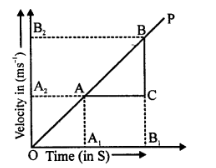
(ii) Acceleration from velocity –time graph : Velocity –time graph for uniform motion is a straight line (OP) inclined to time axis.
Image
Take any two points A and B on this graph. From A and B draw perpendicular on time axis as well as velocity axis in such a way that
$
OA_1=t_1, OB_1=t_2, OA_2=v_1 \text { and } OB_2=v_2$
Slope of $v-t$ graph $=\frac{B C}{A C}$
$=\frac{v_2-v_1}{t_2-t_1}=\frac{\Delta v}{\Delta t}$
$=$ Acceleration of the body
So, by knowing the slope of velocity -time graph for uniform motion, we can find the acceleration of the body.
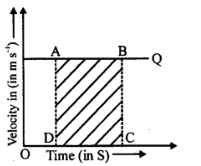
(iii) Displacement from velocity-time graph: Displacement covered by a body is equal to the area under velocity - time graph. When object moves with a uniform velocity, then velocity - time graph is a straight line (PQ) parallel to time axis.
Image
Take any two points $A$ and $B$ on velocity time graph.
From A and B , draw two perpendiculars AD and BC on time axis such that
$
OD=t_1 \text { and } OC=t_2
$
Let $OP = AD = BC =v=$ Velocity of the body.
Area under velocity - time graph = Area of rectangle ABCD .
$= AD \times DC =v \times( OC - OD )=v\left(t_2-t_1\right)$
$=$ Displacement covered by the body.
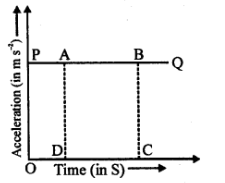
(iv) Velocity from acceleration - time graph : Area under the acceleration - time graph gives the velocity of the body. When the body moves with variable velocity but uniform acceleration, then acceleration - time graph is a straight line $(P Q)$ parallel to time axis.
Image
Take any two points A and B on PQ. From P and Q, draw perpendiculars ( $B C$ and $A D$ ) on time axis. Such that,
$
OD=t_1 \text { and } OC=t_2
$
Let $OP = AD = BC =a=$ acceleration of the body.
Area under acceleration - time graph = area of rectangle
ABCD .
$
\begin{array}{l}
=AD \times DC=AD \times(OC-OD) \\
=a\left(t_2-t_1\right) \\
=\frac{v-u}{\left(t_2-t_1\right)}\left(t_2-t_1\right)=v-u
\end{array}
$
If initial velocity of the body $= u =0$ Then area under acceleration - time graph $= v -0=$ $v=$ velocity of the body.

Need a full question paper?

Generate a complete, print-ready paper with questions like this in minutes — across 16+ boards, with answer keys.

Start Generating Free

Similar questions

Draw diagrams showing the arrangements of the lines of force for:
(a) a single magnet.
(b) two magnets in line, with unlike poles facing one another.
(c) a piece of soft iron laid in line with magnetic field.
A train is moving with a velocity of $90 km h^{-1} $. It is brought to stop by applying the brakes which produce a retardation of $0.5 ms^{-2}$ Find :
(i) The velocity after $10 s$ , and
(ii) the time taken by the train to come to rest .
How does the time period (T) of a simple pendulum depend on its length (l)? Draw a graph showing the variation of $T^2$ with l. How will you use this graph to determine the value of g (acceleration due to gravity)?
Describe in brief, with the aid of a lebelled diagram, an experiment to demonstrate that a material medium is necessary for propagation of sound.
State and explain the law of action and reaction. by giving two examples.
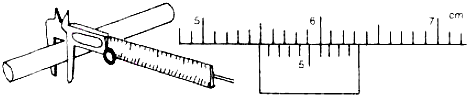
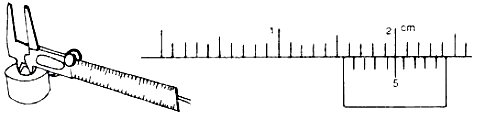
The following diagrams (Fig. 5) show the use of a vernier caliper under three different situations. Study the diagrams carefully and note down the vernier readings in each case.

(a) Measuring the diameter of the rod

(b) Measuring Internal diameter of a cavity

(c) Measuring depth of a cavity
Describe the procedure to measure the diameter of a wire with the help of a screw gauge.
Briefly describe the theory of simple voltaic cell.
Describe an experiment to show that water has maximum density at $4^\circ C.$
What important consequences follow this peculiar property of water? Discuss the importance of this phenomenon in nature.
Distinguish between convergent and divergent beams of light.