Question
How does the behaviour of a real gas differ from the behaviour of an ideal gas? Under what conditions does a real gas behave like an ideal gas?

Answer

SELF

Need a full question paper?

Generate a complete, print-ready paper with questions like this in minutes — across 16+ boards, with answer keys.
Start Generating Free

Similar questions

For the wave described in Exercise 15.8, plot the displacement (y) versus (t) graphs for x = 0, 2 and 4cm. What are the shapes of these graphs? In which aspects does the oscillatory motion in travelling wave differ from one point to another: amplitude, frequency or phase?
A and B are two particles having the same mass 'm'. A is moving along x-axis with a speed of $10ms^{-1}$ and B is at rest. After undergoing a perfectly elastic collision with B, particle A get scattered through an angle of $30°$. What is the direction of the motion of B and the speeds of A and B after the collision?
Two coherent point sources $S_1$ and $S_2$ vibrating in phase emit light of wavelength $\lambda$. The separation between the sources is $2\lambda$. Consider a line passing through $S_2$ and perpendicular to the line $S_1S_2$. What is the smallest distance from $S_2$ where a minimum of intensity occurs?
Explain the principle of moments.
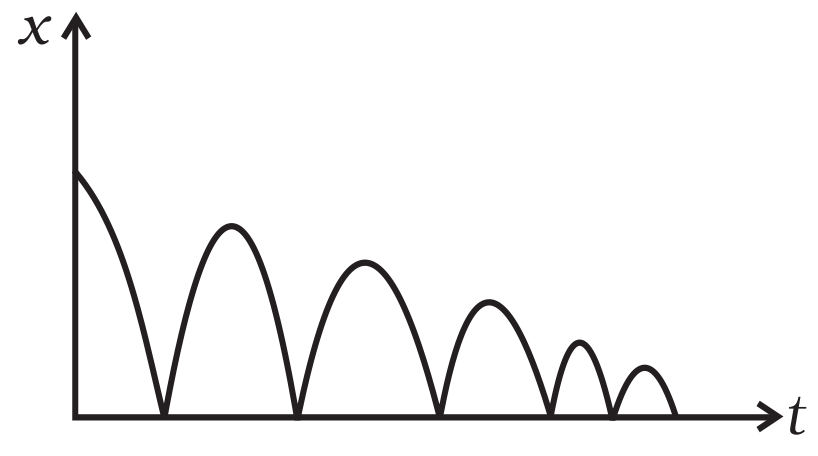
A ball is dropped and its displacement vs time graph is as shown Fig. $($displacement $x$ is from ground and all quantities are $+ve$ upwards$)$.
  1. Plot qualitatively velocity vs time graph.
  2. Plot qualitatively acceleration vs time graph.
The two blocks in an Atwood machine have masses $2.0kg$ and $3.0kg$. Find the work done by gravity during the fourth second after the system is released from rest.
A converging lens of focal length 15cm and a converging mirror of focal length 10cm are placed 50cm apart with common principal axis. A point source is placed in between the lens and the mirror at a distance of 40cm from the lens. Find the locations of the two images formed.
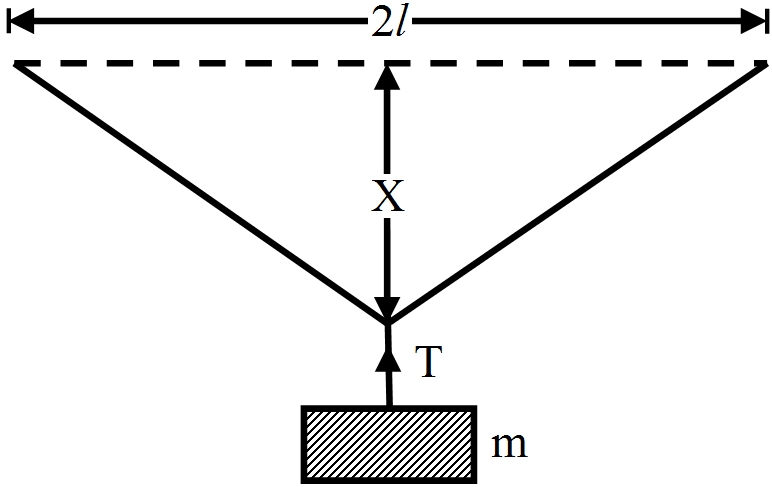
A steel wire of length 2l and cross-sectional area A is stretched within elastic limit as shown in figure. Calculate the strain and stress in the wire.
Quite often, connecting wires carrying currents in opposite directions are twisted together in using electrical appliances. Explain how it avoids unwanted magnetic fields.
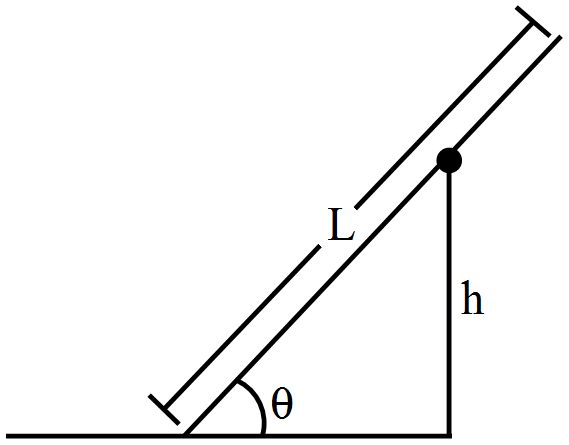
A uniform rod of length L rests against a smooth roller as shown in figure. Find the friction coefficient between the ground and the lower end if the minimum angle that the rod can make with the horizontal is $\theta.$