With the help of suitable diagrams, explain the five stages of prophase-I of meiosis.
Download our app for free and get started
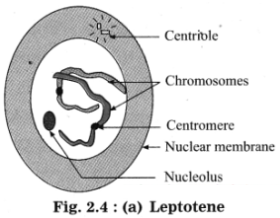
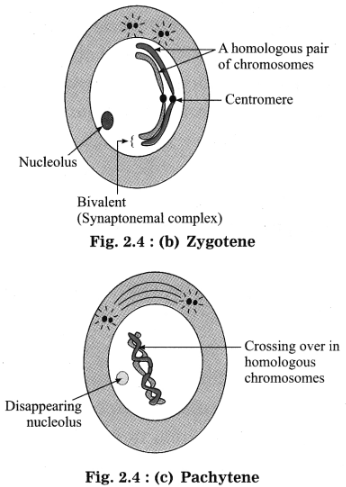
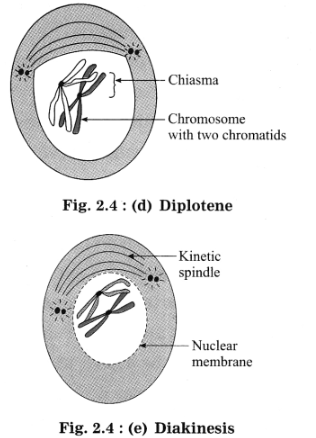
Prophase-I: Prophase – I of meiosis is much longer phase of the meiosis.
It is subdivided into 5 substages, namely leptotene, zygotene, pachytene, diplotene, and diakinesis.
(1) Leptotene: Initially the chromosomes start condensation and they become compact during leptotene.
(2) Zygotene: In zygotene, homologous chromosomes start pairing. This pairing is called synapsis. The structure called synaptonemal complex develops to hold chromosomes in place during this pairing. Each chromosome’s chromatid arm divides and forms structure called bivalent or tetrad.
(3) Pachytene: During pachytene stage, crossing over of non-sister chromatids of homologous chromosomes takes place. Genetic recombination is produced due to such exchange. The homologous chromosomes still remain paired together at the sites of crossing over.
(4) Diplotene: During diplotene, synaptonemal complex dissolves and the homologous chromosomes of the bivalents separate except at the point of crossing over. Thus, it looks like X-shaped structures called the chiasmata.
(5) Diakinesis: The last phase of prophase is for termination of chiasmata. The spindle fibres originate, and the cross-over homologous chromosomes are now separated. The nucleQlus disappears, and the nuclear envelope breaks down.

Download our appand get started for free
Experience the future of education. Simply download our apps or reach out to us for more information. Let's shape the future of learning together!No signup needed.*
Similar Questions
- 1View SolutionHow energy is formed from oxidation of carbohydrates, fats and proteins?
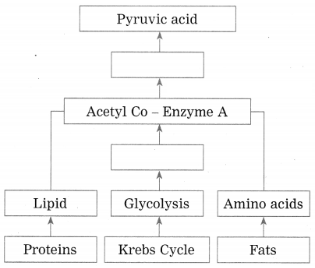
Correct the dagram below.
- 2View SolutionSketch and label the diagram to show ATP – the energy currency of the cell.
- 3View SolutionExplain the Krebs cycle with reaction.
- 4View SolutionExplain the glycolysis in detail.
- 5View SolutionWhat are fatty acids? What are the different uses of fatty acids ?
- 6View SolutionWhat are symptoms of diseases like night blindness, rickets, beriberi, neuritis, pellagra, anaemia, scurvy?
- 7View SolutionWith the help of suitable diagrams, explain the mitosis in detail.
- 8View SolutionObserve the diagrams and answer the following questions.
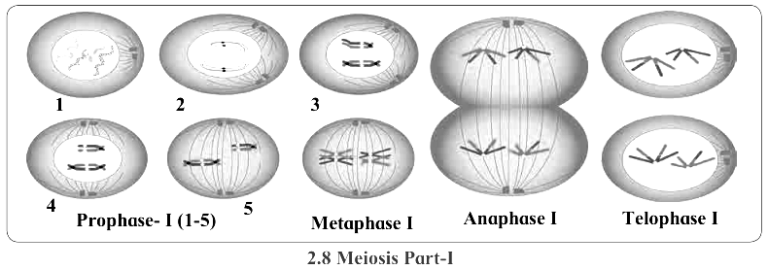
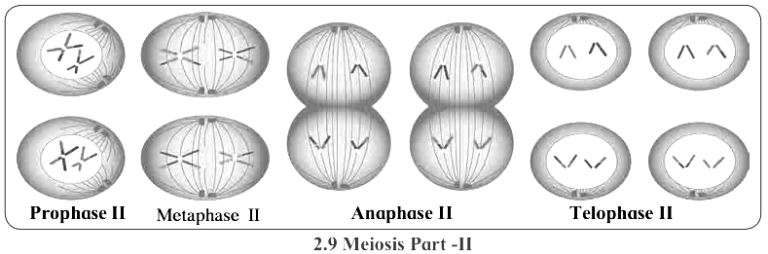
(a) Which peculiarity do you observe in the figure of Metaphase-I of meiosis ?
(b) What is the important difference between Telophase-I and Telophase-II of meiosis?
(c) Which figure shows phenomena of crossing over? - 9View SolutionHow do all the life processes contribute to the growth and development of the body?
- 10View SolutionDraw a neat diagram of the structure of chromosome and label the parts:
(a) Centromere (b) p-arm