MCQ
How many minimum number of non-zero vectors in different planes can be added to give zero resultant
  • A
    $2$
  • B
    $3$
  • $4$
  • D
    $5$

Answer

Correct option: C.
$4$
c
(c) The required number of vectors is $4.$ suppose $A, B, C, D$ are four vectors and no three of them are coplaner. if the resultant of $\mathrm{A}$ and $\mathrm{B}$ be $\mathrm{X},$ and resultant of $\mathrm{C}$ and $\mathrm{D}$ be $\mathrm{Y}$. if $\mathrm{X},$ and $\mathrm{Y}$ be equal in magnitude but in opposing directions, that's the only way the resultant of $A, B, C, D$ be zero, without any three of them being in the same plane.

Need a full question paper?

Generate a complete, print-ready paper with questions like this in minutes — across 16+ boards, with answer keys.
Start Generating Free

Similar questions

Pick the correct statements:
  1. Average speed of a particle in a given time is never less than the magnitude of the average velocity.
  2. It is possible to have a situation in which $\Big|\frac{\text{d}\vec{\text{v}}}{\text{dt}}\Big|\neq0$ but $\frac{\text{d}}{\text{dt}}|\vec{\text{v}}|=0.$
  3. The average velocity of a particle is zero in a time interval. It is possible that the instantaneous velocity is never zero in the interval.
  4. The average velocity of a particle moving on a straight line is zero in a time interval. It is possible that the instantaneous velocity is never zero in the interval.
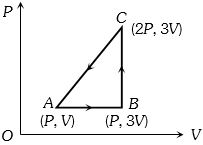
An ideal gas is taken around $ABCA$ as shown in the above $P-V$ diagram. The work done during a cycle is
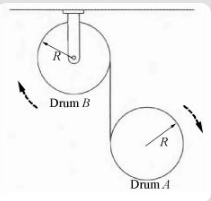
Drum A undergoes:

A body is revolving with a uniform speed $v$ in a circle of radius $r$. The tangential acceleration is
When an object is accelerated:
The pair(s) of physical quantities that have the same dimensions is (are):
A body of mass $5 \,kg$ falls from a height of $30$ metre. If its all mechanical energy is changed into heat, then heat produced will be........ $cal$
Suppose that the speed of sound in air at a given temperature is $400 m/sec$. An engine blows a whistle at $1200 Hz$ frequency. It is approaching an observer at the speed of $100 m/sec$. What is the apparent frequency as heard by the observer .... $Hz$
Two sound waves (expressed in $CGS$ units) given by ${y_1} = 0.3\sin \frac{{2\pi }}{\lambda }(vt - x)$ and ${y_2} = 0.4\sin \frac{{2\pi }}{\lambda }(vt - x + \theta )$ interfere. The resultant amplitude at a place where phase difference is $\pi /2$ will be .... $ cm$
The equation of $SHM$ of a particle is given as

$2\,\frac{{{d^2}x}}{{d{t^2}}} + 32x = 0$

where $x$ is the displacement from the mean position of rest. The period of its oscillation (in seconds) is