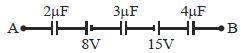
The potential of the point $A$ is greater than that of $B$ by $19\, volt$. What is the potential difference in volts across the $3\,\mu F$ capacitor ?
Medium


Download our appand get started for free
Experience the future of education. Simply download our apps or reach out to us for more information. Let's shape the future of learning together!No signup needed.*
Similar Questions
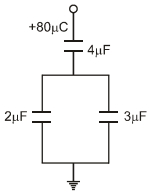
- 1In the given circuit, a charge of $+80 \ \mu C$ is given to the upper plate of the $4 \ \mu F$ capacitor. Then in the steady state, the charge on the upper plate of the $3 \ \mu F$ capacitor is :View Solution
- 2Choose the $CORRECT$ optionView Solution
- 3A condenser of capacity ${C_1}$ is charged to a potential ${V_0}$. The electrostatic energy stored in it is ${U_0}$. It is connected to another uncharged condenser of capacity ${C_2}$ in parallel. The energy dissipated in the process isView Solution
- 4A $10\,pF$ capacitor is connected to a $50 \,V$ battery. How much electrostatic energy is stored in the capacitorView Solution
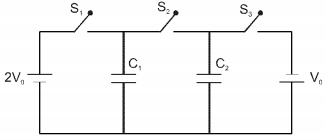
- 5In the circuit shown in the figure, there are two parallel plate capacitors each of capacitance $C$. The switch $S _1$ is pressed first to fully charge the capacitor $C_1$ and then released. The switch $S_2$ is then pressed to charge the capacitor $C _2$. After some time, $S _2$ is released and then $S _3$ is pressed. After some time.View Solution
$(A)$ the charge on the upper plate of $C _1$ is $2 CV _0$
$(B)$ the charge on the upper plate of $C _1$ is $CV _0$
$(C)$ the charge on the upper plate of $C _2$ is $0$
$(D)$ the charge on the upper plate of $C _2$ is $- CV _0$
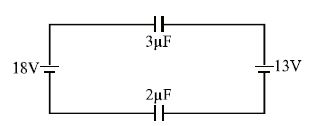
- 6Two batteries and two condensers are connected as shown in the figure. The charge on $2\,\mu F$ capacitor is.....$\mu F$View Solution
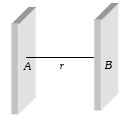
- 7There are two equipotential surface as shown in figure. The distance between them is $r$. The charge of $-q\,$ coulomb is taken from the surface $A$ to $B$, the resultant work done will beView Solution
- 8View SolutionA spherical portion has been removed from a solid sphere having a charge distributed uniformly in its volume in the figure. The electric field inside the emptied space is

- 9View SolutionTwo identical conductors of copper and aluminium are placed in an identical electric fields. The magnitude of induced charge in the aluminium will be
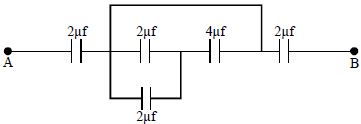
- 10Find the equivalent capacitance between $A$ and $B$.......$\mu f$View Solution