Question
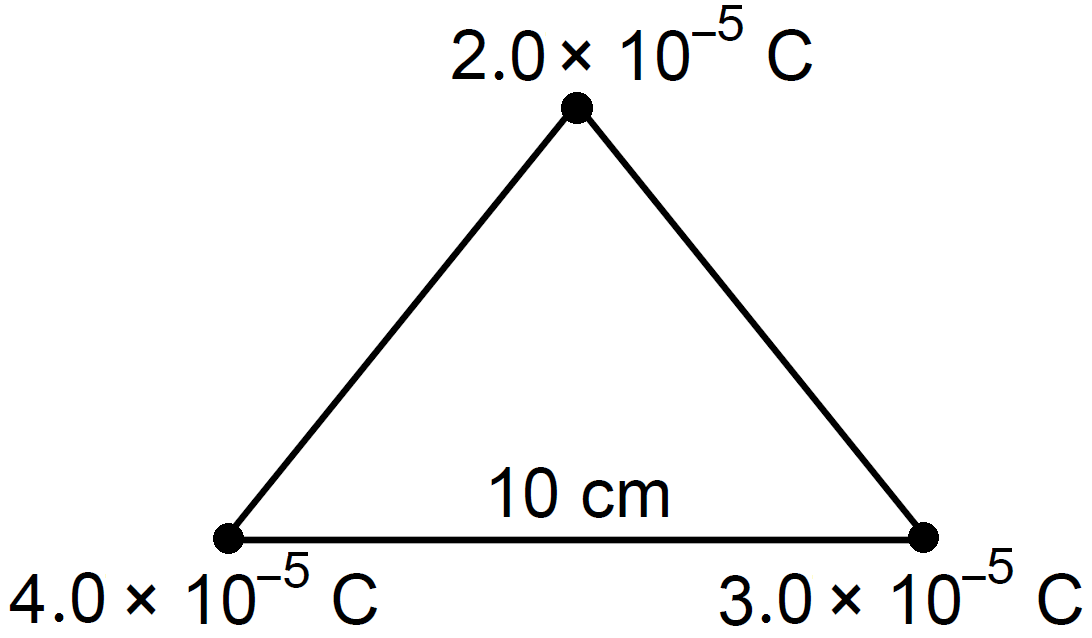
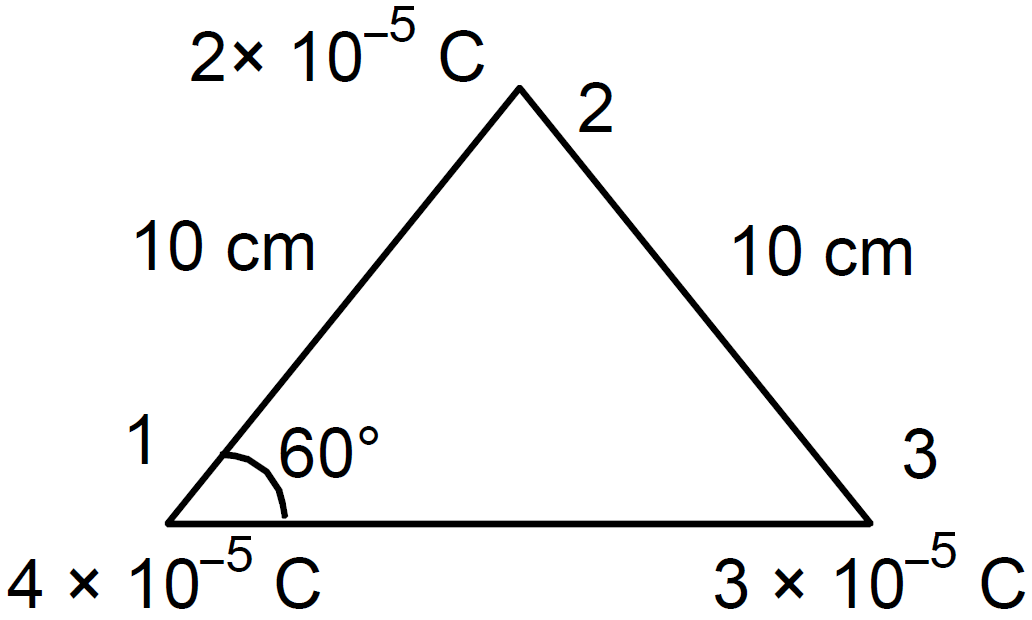
How much work has to be done in assembling three charged particles at the vertices of an equilateral triangle as shown in figure?
Answer

Amount of work done is assembling the charges is equal to the net potential energy

So, P.E. $=\text{U}_{12}+\text{U}_{13}+\text{U}_{23}$
$=\frac{\text{Kq}_1\text{q}_2}{\text{r}_{12}}+\frac{\text{Kq}_1\text{q}_3}{\text{r}_{13}}+\frac{\text{Kq}_2\text{q}_3}{\text{r}_{23}}$
$=\frac{\text{K}+10^{10}}{\text{r}}[4\times2+4\times3+3\times2]$
$=\frac{9\times10^9\times10^{10}}{10^{-1}}(8+12+6)$
$=9\times26$
$=234\text{J}$

Need a full question paper?

Generate a complete, print-ready paper with questions like this in minutes — across 16+ boards, with answer keys.
Start Generating Free

Similar questions

A block of mass $2.0\ kg$ moving at $2.0m/s$ collides head on with another block of equal mass kept at rest.
  1. Find the maximum possible loss in kinetic energy due to the collision.
  2. If the actual loss in kinetic energy is half of this maximum, find the coefficient of restitution.
A vessel of volume $V_0$ contains an ideal gas at pressure $P_0$ and temperature $T$ Gas is continuously pumped out of this vessel at a constant volume$-$ rate $dV\  I\  dt = r$ keeping the temperature constant. The pressure of the gas being taken out equals the pressure inside the vessel. Find, $(1)$ the pressure of the gas as a function of time. $(2)$ the time taken before half the original gas is pumped out.
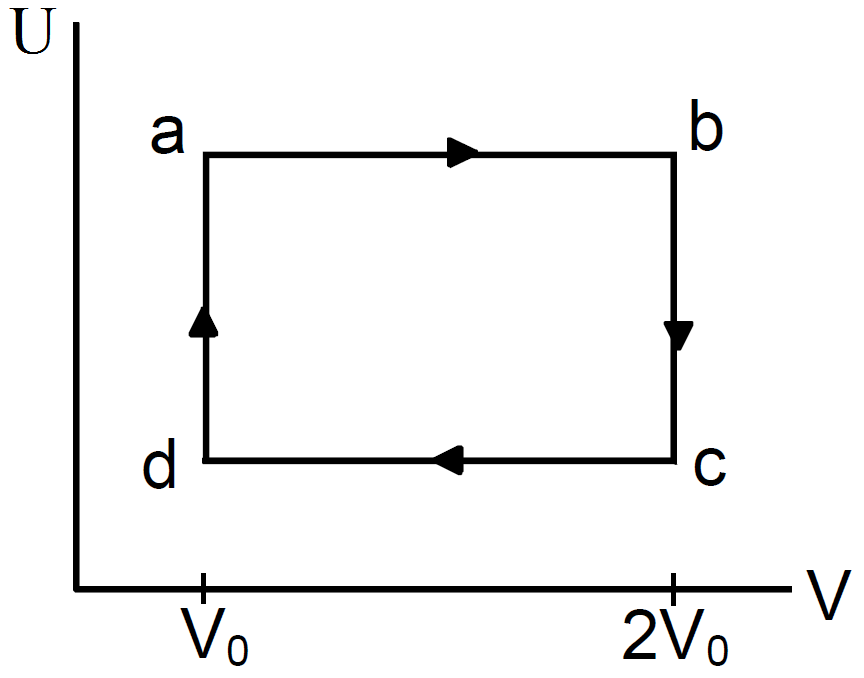
Figure. shows the variation in the internal energy $U$ with the volume $V$ of $2.0\ mol$ of an ideal gas in a cyclic process abcda. The temperatures of the gas at $b$ and $c$ are $500K$ and $300K$ respectively. Calculate the heat absorbed by the gas during the process.
Will the focal length of a lens for red light be more, same or less than that for blue light?
Define capacitance of a capacitor. Derive expression for stored energy between plates of parallel plate capacitor. Show that energy-density between plates of parallel capacitor can be expressed as $\frac{1}{2}\in_{0}E^{2}$ , when E = Electric Field between plates.
  1. Using the Bohr’s model calculate the speed of the electron in a hydrogen atom in the $n = 1, 2,$ and $3$ levels.
  2. Calculate the orbital period in each of these levels.
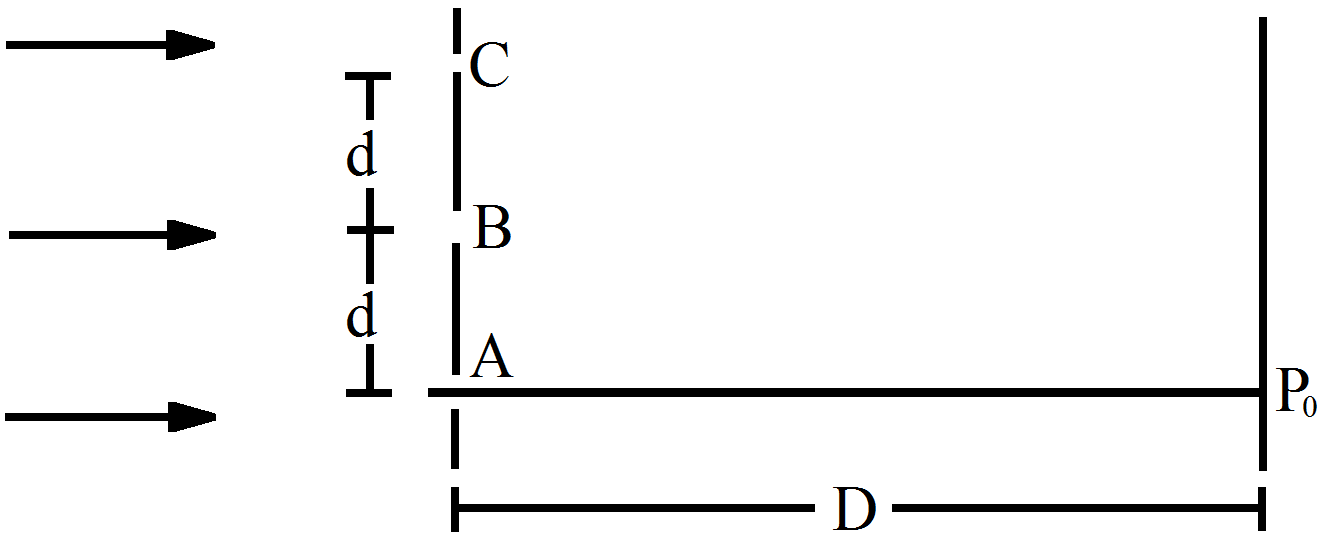
Figure shows three equidistant slits being illuminated by a monochromatic parallel beam of light.
Let $\text{BP}_0-\text{AP}=\frac{\lambda}{3}$ and $\text{D}>\lambda.$
  1. Show that in this case $\text{d}=\sqrt{\frac{2\lambda\text{D}}{3}}.$
  2. Show that the intensity at $P,$ is three times the intensity due to any of the three slits individually.
A circular loop carrying a current i is made of a wire of length L. A uniform magnetic field B exists parallel to the plane of the loop.
  1. Find the torque on the loop.
  2. If the same length of the wire is used to form a square loop, what would be the torque? Which is larger?
A ball is whirled in a circle by attaching it to a fixed point with a string. Is there an angular rotation of the ball about its centre? If yes, is this angular velocity equal to the angular velocity of the ball about the fixed point?
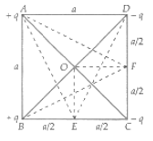
Four charges $+ q ,+ q ,- q$ and $- q$ are placed respectively at the corners $A , B , C$ and $D$ of a square of side a arranged in the given order. Calculate the electric potential at the centre $O$ . If $A$ a $E$ and $F$ are the midpoints of sides $BC$ and $CD$ respectively, what will be the work done in carrying a charge e from $O$ to $E$ and from $O$ to $F$ ?
Image