Questions

5 Marks Questions

Take a timed test

9 questions · self-marked practice — reveal the answer and mark yourself.

Question 15 Marks
A colourless substance $'A\ ' (C_6H_7N)$ is sparingly soluble in water and gives a water soluble compound $'B\ '$ on treating with mineral acid. On reacting with $CHCl_3$ and alcoholic potash $'A\ '$ produces an obnoxious smell due to the formation of compound $'C\ '$. Reaction of $'A\ '$ with benzenesulphonyl chloride gives compound $'D\ '$ which is soluble in alkali. With $NaNO_2$ and $\text{HCl,} 'A\ '$ forms compound $'E\ '$ which reacts with phenol in alkaline medium to give an orange dye $'F\ '.$ Identify compounds $'A\ '$ to $'F\ '.$
View full question & answer
Question 25 Marks
A hydrocarbon $‘A\ ’, (C_4H_8)$ on reaction with $\text{HCl}$ gives a compound $‘B\ ’, (C_4H_9Cl),$ which on reaction with $1$ mol of $NH_3$ gives compound $‘C\ ’, (C_4H_{11}N).$ On reacting with $NaNO_2$ and $\text{HCl}$ followed by treatment with water, compound $‘C\ ’$ ields an optically active alcohol,$ ‘D\ ’.$ Ozonolysis of $‘A\ ’$ gives $2$ moles of acetaldehyde. Identify the compounds $‘A\ ’$ to $‘D\ ’. $Explain the reactions involved.
Answer
$(\text{A})\xrightarrow{\text{Ozonolysis}\ \ }\text{2CH}_3\text{CHO}$$\text{C}_4\text{H}_8\xrightarrow{\text{HCl}\ \ }\text{C}_4\text{H}_9\text{Cl}$ Addition of $\text{HCl}$ has occurred on $'A\ '.$ This implies $'A\ '$ is an alkene.
$\text{C}_4\text{h}_9\text{Cl}\xrightarrow{\ \ \text{NH}\ \ }\text{C}_4\text{H}_{11}\text{N}$
$\text{(B)}\ \ \ \ \ \ \ \ \ \ \ \ \ \ \ \ \ \ \ \ \ \ \text{(C}) Cl$ in compound $'B\ '$ is substituted by $NH_2$ to give $'C\ '$.
$(\text{C})\xrightarrow[\text{H}_2\text{O}]{\text{NaNO}_2/\text{HCl}}(\text{D}) 'C\ '$ gives a diazonium salt with $NaNO_2/HCl$ that liberated $N_2$ to give optically active alcohol. This means that $'C\ '$ is a peimary amine. Number of carbon atoms in amine is same as compound $'A\ '.$
Since products of ozonolysis of compound $'A\ '$ are $CH_3 - CH = O$ and $O = CH - CH_3.$
Therefore, the \ cmpound $'A\ '$ is $CH_3 - CH = CH - CH_3.$
On the basis of structure of $‘A\ ’,$ the reactions can be explained as follows:
$\text{CH}_3-\text{CH}=\text{CH}-\text{CH}_3\xrightarrow{\ \ \ \text{HCl}\ \ } \text{CH}_3\text{CH}_2-\text{CH}-\text{CH}_3$
$\ \ \ \ \ \ \ \ \ \ \ \ \ \ \ \ \ \ \ (\text{A})\ \ \ \ \ \ \ \ \ \ \ \ \ \ \ \ \ \ \ \ \ \ \ \ \ \ \ \ \ \ \ \ \ \ \ \ \ \ \ \ \ \ \ \ \ \ \ \ \ \ |$
$\ \ \ \ \ \ \ \ \ \ \ \ \ \ \ \ \ \ \ \ \ \ \ \ \ \ \ \ \ \ \ \ \ \ \ \ \ \ \ \ \ \ \ \ \ \ \ \ \ \ \ \ \ \ \ \ \ \ \ \ \ \ \ \ \ \ \ \ \ \ \ \ \ \ \text{Cl}$
$\ \ \ \ \ \ \ \ \ \ \ \ \ \ \ \ \ \ \ \ \ \ \ \ \ \ \ \ \ \ \ \ \ \ \ \ \ \ \ \ \ \ \ \ \ \ \ \ \ \ \ \ \ \ \ \ \ \ \ \ \ \ \ \ \ \ \ \ \ \ \text{(B)}$
$\text{CH}_3\text{CH}_2-\text{CH}-\text{CH}_3\xrightarrow{\ \ \ \ \ \text{NH}_3\ \ \ \ }\text{CH}_3- \text{CH}_2-\text{CH}-\text{CH}_3$
$\ \ \ \ \ \ \ \ \ \ \ \ \ \ \ \ \ \ \ \ \ |\ \ \ \ \ \ \ \ \ \ \ \ \ \ \ \ \ \ \ \ \ \ \ \ \ \ \ \ \ \ \ \ \ \ \ \ \ \ \ \ \ \ \ \ \ \ \ \ \ \ \ \ \ \ \ \ \ \ |$
$\ \ \ \ \ \ \ \ \ \ \ \ \ \ \ \ \ \ \ \ \text{Cl}\ \ \ \ \ \ \ \ \ \ \ \ \ \ \ \ \ \ \ \ \ \ \ \ \ \ \ \ \ \ \ \ \ \ \ \ \ \ \ \ \ \ \ \ \ \ \ \ \ \ \ \ \ \ \ \ \text{NH}_2$
$\ \ \ \ \ \ \ \ \ \ \ \ \ \ \ \ \text{(B)}\ \ \ \ \ \ \ \ \ \ \ \ \ \ \ \ \ \ \ \ \ \ \ \ \ \ \ \ \ \ \ \ \ \ \ \ \ \ \ \ \ \ \ \ \ \ \ \ \ \ \ \ \text{(C)}$
$ \ \ \ \ \ \ \ \ \ \ \ \ \ \ \ \ \ \ \ \ \ \ \ \ \ \ \ \ \ \ \ \ \ \ \ \ \ \ \ \ \ \ \ \ \ \ \ \ \ \ \ \ \ \ \ \ \ \ \ \ \ \ \ \ \ \ \ \ \ \ \ \ \ \ \ \ \ \ \ \ \ \ \ \ \ \ \ \ \ \ \text{CH}_2\text{CH}_3$
$\ \ \ \ \ \ \ \ \ \ \ \ \ \ \ \ \ \ \ \ \ \ \ \ \ \ \ \ \ \ \ \ \ \ \ \ \ \ \ \ \ \ \ \ \ \ \ \ \ \ \ \ \ \ \ \ \ \ \ \ \ \ \ \ \ \ \ \ \ \ \ \ \ \ \ \ \ \ \ \ \ \ \ \ \ \ \ \ \ \ |$
$\text{CH}_3-\text{CH}_2-\text{CH}-\text{CH}_3\xrightarrow[\text{H}_2\text{O}]{\ \ \text{Na}\text{NO}_2/\text{HCl}\ \ }\text{CH}_3-\text{CH}-\text{C}-\text{H}$
$\ \ \ \ \ \ \ \ \ \ \ \ \ \ \ \ \ \ \ \ \ \ \ \ \ | \ \ \ \ \ \ \ \ \ \ \ \ \ \ \ \ \ \ \ \ \ \ \ \ \ \ \ \ \ \ \ \ \ \ \ \ \ \ \ \ \ \ \ \ \ \ \ \ \ \ \ \ \ \ \ \ \ \ \ \ \ \ \ \ |$
$\ \ \ \ \ \ \ \ \ \ \ \ \ \ \ \ \ \ \ \ \ \ \ \ \ \text{NH}_2 \ \ \ \ \ \ \ \ \ \ \ \ \ \ \ \ \ \ \ \ \ \ \ \ \ \ \ \ \ \ \ \ \ \ \ \ \ \ \ \ \ \ \ \ \ \ \ \ \ \ \ \ \ \ \ \ \text{OH}$
$\ \ \ \ \ \ \ \ \ \ \ \ \ \ \ \ \ \ \ \text{(C}) \ \ \ \ \ \ \ \ \ \ \ \ \ \ \ \ \ \ \ \ \ \ \ \ \ \ \ \ \ \ \ \ \ \ \ \ \ \ \ \ \ \ \ \ \ \ \ \ \ \ \ \text{(Optically active)}$
$\ \ \ \ \ \ \ \ \ \ \ \ \ \ \ \ \ \ \ \ \ \ \ \ \ \ \ \ \ \ \ \ \ \ \ \ \ \ \ \ \ \ \ \ \ \ \ \ \ \ \ \ \ \ \ \ \ \ \ \ \ \ \ \ \ \ \ \ \ \ \ \ \ \ \ \ \ \ \ \ \ \ \ \ \ \ \text{(D})$
View full question & answer
Question 35 Marks
Answer the following questions:
How will you bring about the following conversions?
  1. Ethanamine into methanamine.
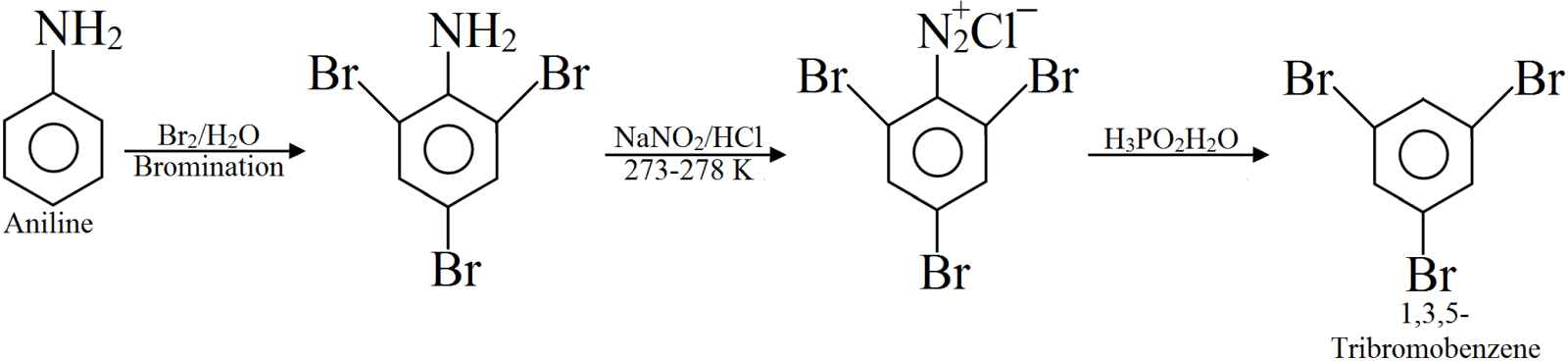
  2. Aniline into 1, 3, 5-tribromobenzene.
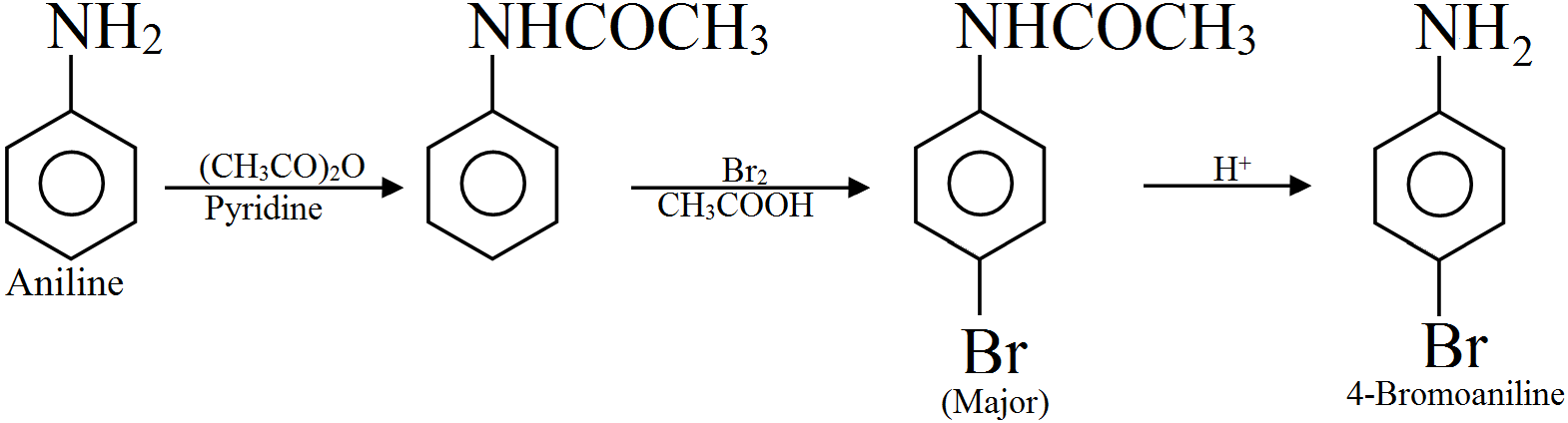
  3. Aniline into 4-bromoaniline.
Answer
  1.  
  1.  
  1.  
View full question & answer
Question 45 Marks
A hydrocarbon $'A', (C_4H_8)$ on reaction with $HCl$ gives a compound $'B', (C_4H_9Cl)$, which on reaction with $1 \ mol$ of $NH_3$ gives compound $'C', (C_4H_{11}N)$. On reacting with $NaNO_2$ and $HCl$ followed by treatment with water, compound $'C\ '$ yields an optically active alcohol,$'D\ '$. Ozonolysis of $'A\ '$ gives $2$ mols of acetaldehyde. Identify compounds $'A\ '$ to $'D\ '$. Explain the reactions involved.
Answer
Addition of $HCl$ has occurred on $'A'$. This implies $'A'$ is an alkene.$\text{A}\xrightarrow{\text{Ozonolysis}}2\text{CH}_3\text{CHO}$
$\text{C}_4\text{H}_8\xrightarrow{\text{HCl}}\text{C}_4\text{H}_9\text{Cl}$
$\ \ \text{(A)}\ \ \ \ \ \ \ \ \ \ \ \ \ \ \ \text{(B)}$
$Cl$ in compound $‘B’$ is substituted by $NH_2$ to give $‘C’$.$\text{C}_4\text{H}_9\text{Cl}\xrightarrow{\text{NH}_3}\text{C}_4\text{H}_{11}\text{N}$
$\ \ \text{(B)}\ \ \ \ \ \ \ \ \ \ \ \ \ \ \ \text{(C)}$
$‘C’$ gives a diazonium salt with $NaNO_2 /HCl$ that liberates $N_2$ to give optically active alcohol. This means that $‘C’$ is an aliphatic amine. Number of carbon atoms in amine is same as in compound $‘A’.\text{(C)}\xrightarrow[\text{H}_2\text{O}]{\text{NaNO}_2/\text{HCl}}\text{(D)}$
Since products of ozonolysis of compound $‘A’$ are $CH_3-CH-O$ and $O-CH-CH_3$. The compound $‘A’$ is $CH_3-CH-CH-CH_3$. On the basis of structure of $‘A’$ reactions can be explained as follows
:$\text{CH}_3\text{A}-\text{CH}=\text{CH}-\text{CH}_3\xrightarrow{\ \ \text{HCl}\ \ }\text{CH}_3\text{CH}_2-\text{CH}-\text{CH}_3\\\ \ \ \ \ \ \ \ \ \ \ \ \ \ \ \ \ \ \ \ \ \ \ \ \ \ \ \ \ \ \ \ \ \ \ \ \ \ \ \ \ \ \ \ \ \ \ \ \ \ \ \ \ \ \ \ \ \ \ \ \ \ \ \ \ \ \ \ \ \ \ \ \ \ \ \ \ \ |\\\ \ \ \ \ \ \ \ \ \ \ \ \ \ \ \ \ \ \ \ \ \ \ \ \ \ \ \ \ \ \ \ \ \ \ \ \ \ \ \ \ \ \ \ \ \ \ \ \ \ \ \ \ \ \ \ \ \ \ \ \ \ \ \ \ \ \ \ \ \ \ \ \ \ \ \ \ \text{Cl}\\\ \ \ \ \ \ \ \ \ \ \ \ \ \ \ \ \ \ \ \ \ \ \ \ \ \ \text{(A)}\ \ \ \ \ \ \ \ \ \ \ \ \ \ \ \ \ \ \ \ \ \ \ \ \ \ \ \ \ \ \ \ \ \ \ \ \ \ \ \ \ \ \ \ \text{(B)}$
$\text{CH}_3-\text{CH}_2-\text{CH}-\text{CH}_3\xrightarrow{\text{NH}_3}\text{CH}_3-\text{CH}_2-\text{CH}-\text{CH}_3\\\ \ \ \ \ \ \ \ \ \ \ \ \ \ \ \ \ \ \ \ \ \ \ \ \ \ |\ \ \ \ \ \ \ \ \ \ \ \ \ \ \ \ \ \ \ \ \ \ \ \ \ \ \ \ \ \ \ \ \ \ \ \ \ \ \ \ \ \ \ \ \ \ \ \ \ \ \ \ \ |\\\ \ \ \ \ \ \ \ \ \ \ \ \ \ \ \ \ \ \ \ \ \ \ \ \ \text{Cl}\ \ \ \ \ \ \ \ \ \ \ \ \ \ \ \ \ \ \ \ \ \ \ \ \ \ \ \ \ \ \ \ \ \ \ \ \ \ \ \ \ \ \ \ \ \ \ \ \ \ \text{NH}_3\\\ \ \ \ \ \ \ \ \ \ \ \ \ \ \ \ \ \ \ \ \ \ \ \ \ \text{(B)}\ \ \ \ \ \ \ \ \ \ \ \ \ \ \ \ \ \ \ \ \ \ \ \ \ \ \ \ \ \ \ \ \ \ \ \ \ \ \ \ \ \ \ \ \ \ \ \ \text{(C)}$
$\ \ \ \ \ \ \ \ \ \ \ \ \ \ \ \ \ \ \ \ \ \ \ \ \ \ \ \ \ \ \ \ \ \ \ \ \ \ \ \ \ \ \ \ \ \ \ \ \ \ \ \ \ \ \ \ \ \ \ \ \ \ \ \ \ \ \ \ \ \ \ \ \ \ \ \ \text{CH}_2\text{CH}_3\\\ \ \ \ \ \ \ \ \ \ \ \ \ \ \ \ \ \ \ \ \ \ \ \ \ \ \ \ \ \ \ \ \ \ \ \ \ \ \ \ \ \ \ \ \ \ \ \ \ \ \ \ \ \ \ \ \ \ \ \ \ \ \ \ \ \ \ \ \ \ \ \ \ \ \ \ \ |\\\text{CH}_3-\text{CH}_2-\text{CH}-\text{CH}_3\xrightarrow[\text{H}_2\text{O}]{\text{NaNO}_2/\text{HCl}}\text{CH}_3-\text{C}-\text{H}\\\ \ \ \ \ \ \ \ \ \ \ \ \ \ \ \ \ \ \ \ \ \ \ \ \ \ |\ \ \ \ \ \ \ \ \ \ \ \ \ \ \ \ \ \ \ \ \ \ \ \ \ \ \ \ \ \ \ \ \ \ \ \ \ \ \ \ \ \ \ \ \ \ \ \ \ \ |\\\ \ \ \ \ \ \ \ \ \ \ \ \ \ \ \ \ \ \ \ \ \ \ \ \ \text{NH}_2\ \ \ \ \ \ \ \ \ \ \ \ \ \ \ \ \ \ \ \ \ \ \ \ \ \ \ \ \ \ \ \ \ \ \ \ \ \ \ \ \ \ \ \text{OH}\\\ \ \ \ \ \ \ \ \ \ \ \ \ \ \ \ \ \ \ \ \ \ \ \ \ \ \ \ \ \ \ \ \ \ \ \ \ \ \ \ \ \ \ \ \ \ \ \ \ \ \ \ \ \ \ \ \ \ \ \ \ \ \ \ \text{(Optically active)}\\\ \ \ \ \ \ \ \ \ \ \ \ \ \ \ \ \ \ \ \ \ \ \ \text{(C)}\ \ \ \ \ \ \ \ \ \ \ \ \ \ \ \ \ \ \ \ \ \ \ \ \ \ \ \ \ \ \ \ \ \ \ \ \ \ \ \ \ \ \ \ \ \ \text{(D)}$
View full question & answer
Question 55 Marks
$\text{[A], [B], [C], [D], [E], [F]}$ and $[G]$ are amines each of which forms a hydrochloride containing $32.42\%$ chlorine. $\text{[A], [B], [C]}$ and $[D]$ evolve $N_2$ on reaction with $HNO_2$, but $\text{[E], [F], [G]}$ and $[H]$ do not. Give structures of $[A]$ to $[H]$ with reasons.
Answer
Let the molecular formula of the six amines be $CnH_{2n+1}NH_2$,
where $n = 1, 2, 3$, etc. As all the seven amines react with $HCl$ to form hydrochlorides, therefore, the molecular formula of their hydrochloride is,$\text{C}_\text{n}\text{H}_{2\text{n}+1}\text{NH}_2+\text{HCl}\xrightarrow{\ \ \ \ \ \ \ \ \ \ \ \ }\text{C}_\text{n}\text{H}_{\text{2n}+1}\stackrel{{+\ \ \ \ \ \ }}{\hbox{N}\text{H}_3}\text{Cl}^-$
As all these hydrochlorides contain $32.4\%$ of $Cl$, therefore molecular mass of amines,$\frac{100\times35.5}{3.42}=109.5$
Now, molecular mass of $= 109.5 12n + 2n + 1 + 14 + 3 + 35.5 = 109.5$ or $14n = 56$
$\Rightarrow n = 4$
$\therefore$ Molecular formula of the six amines $= C_4H_9NH_2$
As amines $[A], [B], [C]$ and $[D]$ evolve $N_2$ on treatment with $HNO_2$, they must be primary amines,$\text{C}\text{n}\text{H}_{\text{2n}+1}\text{NH}_2+\text{HCl}\xrightarrow{\ \ \ \ \ \ \ \ }\text{C}_\text{n}\text{H}_{\text{2n}+1}\stackrel{{+\ \ \ \ \ \ }}{\hbox{N}\text{H}_3}\text{Cl}^-$
The four primary amines having molecular formula $C_4H_9NH_2$ are:
$\text{CH}_3-\text{CH}_2-\text{CH}_2-\text{CH}_2-\text{NH}_2\\\text{Buttana mine [A]}$   $\text{CH}_3-\text{CH}_3-\text{CH}_2-\text{CH}-\text{CH}_3\\\ \ \ \ \ \ \ \ \ \ \ \ \ \ \ \ \ \ \ \ \ \ \ \ \ \ \ \ \ \ \ \ \ \ \ \ \ \ |\\ \ \ \ \ \ \ \ \ \ \ \ \ \ \ \ \ \ \ \ \ \ \ \ \ \ \ \ \ \ \ \ \ \ \ \ \ \text{NH}_2\\\ \ \ \ \ \ \ \ \ \ \ \ \ \ \ \ \ \ \ \text{Butan - 2- amine [B]}$
     
$\text{CH}_3\\|\\\text{CH}_3-\text{CH}-\text{CH}_2-\text{NH}_2\\\text{2-Methyl propana mine [C]}$   $\ \ \ \ \ \ \ \ \ \ \ \text{CH}_3\\\ \ \ \ \ \ \ \ \ \ \ \ \ | \\\text{CH}_3-\text{C}-\text{CH}_3\\\ \ \ \ \ \ \ \ \ \ \ \ \ | \\\ \ \ \ \ \ \ \ \ \ \ \ \text{NH}_2\\ \text{2-Methyl propan -2- amine [D]}$
As amines $[E], [F], [G]$ and $[H]$ do not react with $HNO_2$, to evolve $N_2$, therefore, they must be either secondary or tertiary amines.
$\text{CH}_3-\text{CH}_2-\text{CH}_2-\text{NH}-\text{CH}_3\\ \text{N-Methyl propana mine [E]}$   $\text{CH}_3-\text{CH}_2-\text{NH}-\text{CH}_2-\text{CH}_3\\ \text{N-Ethylethana mine [F]}$
     
$\ \ \ \ \ \ \ \ \ \ \ \ \ \text{CH}_3\\ \ \ \ \ \ \ \ \ \ \ \ \ \ |\\ \text{CH}_3-\text{CH}-\text{NH}-\text{CH}_3\\ (\text{N-Methyl}) \text{propan-2- a mine [G]}$   $\ \ \ \ \ \ \ \ \ \ \ \ \ \ \ \ \ \ \ \ \ \ \ \ \ \text{CH}_3\\ \ \ \ \ \ \ \ \ \ \ \ \ \ \ \ \ \ \ \ \ \ \ \ \ \ \ |\\\text{CH}_3-\text{CH}_2-\text{N}-\text{CH}_3\\ \text{N, N- Dimethyl ethana mine (H)}$
View full question & answer
Question 85 Marks
Answer the following questions:Account for the following$:$
  1. Methylamine in water reacts with ferric chloride to precipitate hydrated ferric oxide.
  2. Diazonium salts of aromatic amines are more stable than those of aliphatic amines.
Answer
  1. Methylamine being more basic than water, accepts a proton from water, liberating $OH^-$ ions.

These $OH^-$ ions combine with $Fe^{3+}$​​​​​​​ ions present in $H_2O$ to form brown precipitate of hydrated ferric oxide.
$\text{FeCl}_3\xrightarrow{\ \ \ \ \ }\text{Fe}^{3+}+3\text{Cl}^-$
$2\text{Fe}^{3+}\text{6OH}^-\xrightarrow{\ \ \ \ \ \ \ \ \ }2\text{Fe}(\text{OH})_3\text{ or Fe}_2\text{O}_3.3\text{H}_2\text{O}\\ \ \ \ \ \ \ \ \ \ \ \ \ \ \ \ \ \ \ \ \ \ \ \ \ \ \ \ \ \ \ \ \ \ \ \text{Hydrated ferricaxide}\\ \ \ \ \ \ \ \ \ \ \ \ \ \ \ \ \ \ \ \ \ \ \ \ \ \ \ \ \ \ \ \ \ \ \ \ \ \ \ \ \ \text{(Brown ppt)}$
  1. The diazonium salts of aromatic amines are more stable than those of aliphatic amines due to dispersal of the positive charge on the benzene ring as shown below:
View full question & answer