Question

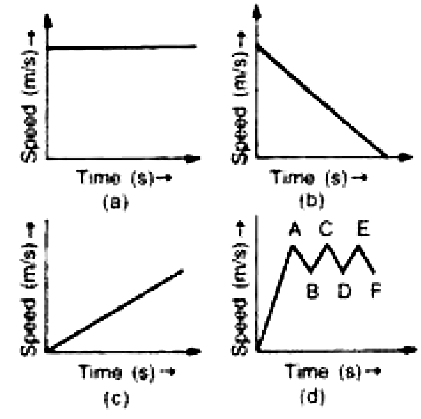
(i) In speed time graph uniform motion is given by a straight line parallel to x axis so figure (a) denotes the uniform motion.
(ii) In speed time graph motion with increasing speed is shown by straight line with positive slope so figure (c) denotes the motion with speed increasing.
(iii) In speed time graph motion with decreasing speed is shown by straight line with negative slope so figure (b) denotes the motion with speed decreasing.
(iv) In speed time graph motion with oscillating speed is shown by zigzag line so figure {d) denotes the motion with speed oscillating.
Answer


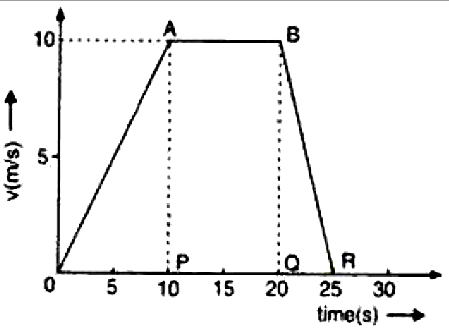
As we know that acceleration is given by the slope of the velocity-time graph so we have to calculate the slope of the graph of each stage of motion,
Acceleration during $O$ to $P=(10-0) /(10-0)=1 ms^{-2}$
Acceleration during $P$ to $Q=(10-10) /(20-10)=0 ms^{-2}$
Acceleration during $Q$ to $R=(0-10) /(25-20)=-2 ms^{-2}$

Need a full question paper?

Generate a complete, print-ready paper with questions like this in minutes — across 16+ boards, with answer keys.

Start Generating Free

Similar questions

(a) State Archimedes' Principle.
(b) A block of mass 7 kg and volume $0.07 m^3$ floats in a liquid of density $140 kg / m ^3$.
Calculate:
1. Volume of block above the surface of liquid.
2. Density of block.
A body of volume V and density $\rho_{ s }$, floats with volume v inside a liquid of density $\rho_{ L }$. Show that $\frac{v}{V}=\frac{\rho_s}{\rho_L}$
A simple $U$ tube contains mercury to the same level in both of its arms. If water is poured to a height of 13.6 cm in one arm, how much will be the rise in mercury level in the other arm? Given : density of mercury $=13.6 \times 10^3 kg m ^{-3}$ and density of water $=$ $10^3 kg m ^{-3}$.
What do you understand by the following terms as applied to screw gauge?
(a) Zero error
(b) Positive zero error
(c) Negative zero error.
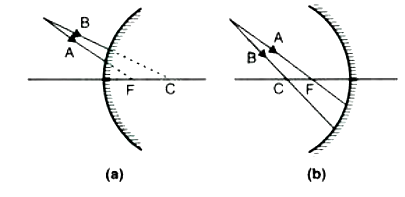
Complete the following diagrams shown in Fig. by drawing the reflected ray for each of the incident ray A and B.
A train travels the first 30km of its journey at 30km/h. Find the speed it should travel the next 90km to have an average speed of 60km/h.
Draw a velocity-time graph for a body moving with an initial velocity u and uniform acceleration a. Use this graph to find the distance travelled by the body in time t.
(a) Define force.
(b) State four effects which a force can bring about. Give two examples in each case.
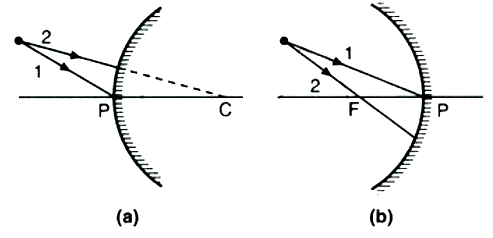
Complete the following diagrams in Figure by drawing the reflected rays for the incident rays 1 and 2.
QUESIION A metal cube of edge 5 cm and density $9 g cm ^{-3}$ is suspended by a thread so as to be completely immersed in a liquid of density $1.2 g cm ^{-3}$. Find the tension in thread. (Take $g =10 m s ^{-2}$ )