Question
Explain elasticity of behaviour.

Answer

SELF

Need a full question paper?

Generate a complete, print-ready paper with questions like this in minutes — across 16+ boards, with answer keys.
Start Generating Free

Similar questions

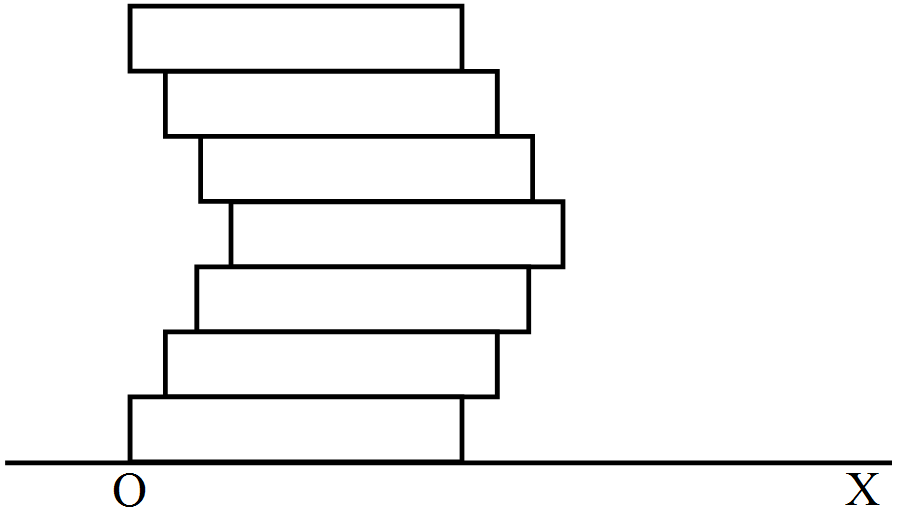
Seven homogeneous bricks, each of length L, are arranged as shown in figure. Each brick is displaced with respect to the one in contact by $\frac{\text{L}}{10}.$ Find the x-coordinate of the centre of mass relative to the origin shown.
What is a heat engine? What are its essential parts? Explain its principle and establish the formula for its efficiency.
Show that the gravitational potential at a point of distant r from the mass M is given by, $\text{V}=-\Big(\frac{\text{GM}}{\text{r}}\Big)$
Ten small planes are flying at a speed of 150km/h in total darkness in an air space that is 20 × 20 × 1.5km 3 in volume. You are in one of the planes, flying at random within this space with no way of knowing where the other planes are. On the average about how long a time will elapse between near collision with your plane. Assume for this rough computation that a safety region around the plane can be approximated by a sphere of radius 10m.
A circular disc of mass $10kg$ is suspended by a wire attached to its centre. The wire is twisted by rotating the disc and released. The period of torsional oscillations is found to be $1.5s$. The radius of the disc is $15cm$. Determine the torsional spring constant of the wire. (Torsional spring constant $\alpha$ is defined by the relation $\text{J}=-\alpha\theta,$ where J is the restoring couple and $\theta$ the angle of twist).
  1. State first law of thermodynamics. What are its limitations? Why $C_p > C_v$?
  2. An electric heater supplies heat to a system at a rate 100W. If the system performs work at a rate of 75 joules per second at what rate is the internal energy increases.
OR
  1. Derive an expression for the work done during the isothermal expression of x mole of an ideal gas.
  2. A steam engine delivers $5.4 \times 10^8J$ of work per minute and services $3.6 \times 10^9J$ of heat per minute from its boiler. What is the efficiency of the engine? How much heat is wasted per minute?
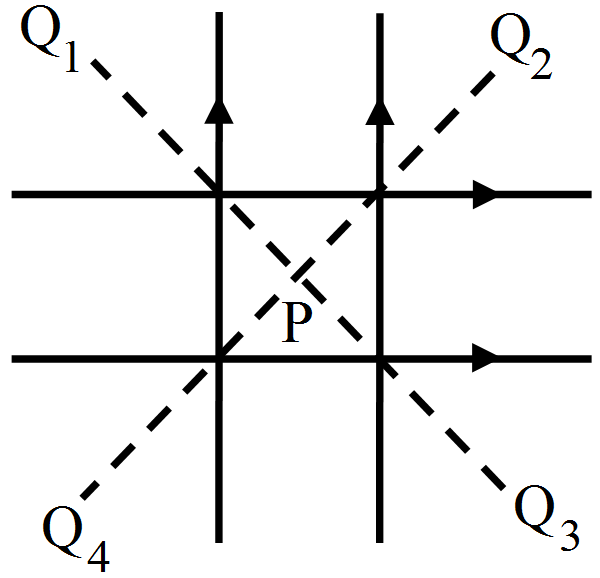
Four long, straight wires, each carrying a current of $5.0A$, are placed in a plane as shown in figure. The points of intersection form a square of side $5.0cm$.
  1. Find the magnetic field at the centre P of the square.
  2. $Q_1, Q_2, Q_3,$ and $Q_4$ are points situated on the diagonals of the liquare and at a distance from P that is equal to the length of the diagonal of the square. Find the magnetic fields at these points.
In an experiment on photoelectric effect, the stopping potential is measured for monochromatic light beams corresponding to different wavelengths. The data collected are 11s follows:
wavelength (nm) 350 400 450 500 550
stopping potential(V): 1.45 1.00 0.66 0.38 0.16
Plot the stopping potential against inverse of wavelength $\big(\frac{1}{\lambda}\big) $ on a graph paper and find
  1. The Planck constant,
  2. The work function of the emitter and.
  3. The threshold wavelength.
From a certain apparatus, the diffusion rate of hydrogen has an average value of $28.7 \mathrm{~cm}^3 \mathrm{~s}^{-1}$. The diffusion of another gas under the same conditions is measured to have an average rate of $7.2 \mathrm{~cm}^3 \mathrm{~s}^{-1}$. Identify the gas. [Hint: Use Graham's law of diffusion $\frac{\mathrm{R}_1}{\mathrm{R}_2}=\left(\frac{\mathrm{M}_2}{\mathrm{M}_1}\right)^{\frac{1}{2}}$, where $\mathrm{R}_1, \mathrm{R}_2$ are diffusion rates of gases 1 and 2 , and $\mathrm{M}_1$ and $\mathrm{M}_2$ their respective molecular masses. The law is a simple consequence of kinetic theory]
The displacement vector of a particle of mass m is given by $\text{r}\text{(t})=\hat{\text{i}}\text{A}\cos\omega\text{t}+\hat{\text{j}}\text{B}\sin\omega\text{t}.$Show that $\text{F}=-\text{m}\omega^2\text{r}.$