Question
Identify the following electromagnetic radiations as per the wavelengths given below.
  1. $10^{-3}\ nm$
  2. $10^{-3}m$
  3. $1\ nm$
Write one application of each.

Answer

  1. $10^{-3}nm \rightarrow$ gamma radiation.
Application: Radio therapy or to initiate nuclear reactions.
  1. $10^{-3}m \rightarrow$ microwaves.
Application: In $\text{RADAR}$ for aircraft navigation.
  1. $1nm \rightarrow X-$ray.
Application: In medical science for detection of fractures, stones in kidney, gallbladder etc.

Need a full question paper?

Generate a complete, print-ready paper with questions like this in minutes — across 16+ boards, with answer keys.
Start Generating Free

Similar questions

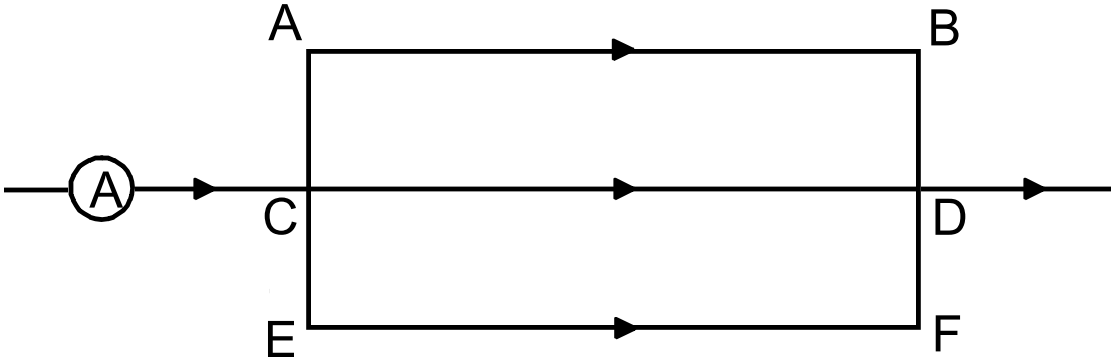
Figure shows a part of an electric circuit. The wires $AB, CD$ and $EF$ are long and have identical resistances. The separation between the neighbouring wires is $1.0\ cm.$ The wires $AE$ and $BF$ have negligible resistance and the ammeter reads $30A.$ Calculate the magnetic force per unit length of $AB$ and $CD.$
Using $\text{B}=\mu_0\text{H},$ find the ratio $\frac{\text{E}_0}{\text{H}_0}$ for a plane electromagnetic wave propagating through vacuum. Show that it has the dimensions of electric resistance. This ratio is a universal constant called the impedance of free space.
Derive the equation of the missing term in the Ampere circuital law $OR$ Derive the equation of displacement current and write its unit and definition.
Establish a relationship between electric current and drift velocity. Draw the direction of electron flowing in a circuit by drawing an electric circuit.
Prove that the magnitude of electric current in a circuit is proportional to the drift velocity of free electrons. Verify Ohm's law with the help of drift velocity.
A bar magnet of magnetic moment 6J/T is aligned at 60° with a uniform external magnetic field of 0·44T. Calculate (a) the work done in turning the magnet to align its magnetic moment (i) normal to the magnetic field, (ii) opposite to the magnetic field, and (b) the torque on the magnet in the final orientation in case (ii).
A body of mass 2kg suspended through a vertical spring executes simple harmonic motion of period 4s. If the oscillations are stopped and the body hangs in equilibrium, find the potential energy stored in the spring.
Two long strings $A$ and $B,$ each having linear mass density $1.2 \times 10^{-2}\ kg/m$, are stretched by different tensions $4.8N$ and $7.5N$ respectively and are kept parallel to each other with their left ends at $x = 0.$ Wave pulses are produced on the strings at the left ends at $t = 0$ on string $A$ and at $t = 20\ ms$ on string $B.$ When and where will the pulse on $B$ overtake that on $A$?
An $AC$ voltage $V = V_m$ is applied across a:
  1. Series $RC$ circuit in which capacitive reactance is $‘a\ ’$ times the resistance in the circuit.
  2. Series $RL$ circuit in which inductive reactance is $‘b\ ’$ times the resistance in the circuit.
Find the value of power factor of the circuit in each case.
  1. Draw a schematic ray diagram of a compound microscope when image is formed at distance of distinct vision.
  2. Write the expression for resolving power of a compound microscope. How can the resolving power of a microscope be increased?