Question
Identify the function which represents a periodic motion.

Answer

For periodic function

$f(t)=f(t+T)$

where $T$ is time period of function

$\sin (\omega t+2 \pi)+\cos (\omega t+2 \pi)$

$=\sin \omega t+\cos \omega t$

Need a full question paper?

Generate a complete, print-ready paper with questions like this in minutes — across 16+ boards, with answer keys.
Start Generating Free

Similar questions

If two liquids of same volume but different densities ${\rho _1}$ and ${\rho _2}$ are mixed, then density of mixture is given by
In sample of pure silicon,$10^{13}\,atom/cm^3$ is mixed of phosphorus. If all donor atoms are active then what will be resistivity at $20\,^oC$ if mobility of electron is $1200\,cm^2/volt-s$ ?.......$ohm\,cm$
The distance covered by a particle undergoing $SHM$ in one time period is (amplitude $= A$)
An elementary particle of mass $m$ and charge $+e$ is projected with velocity $v$ at a much more massive particle of charge $Ze$, where $Z > 0$. What is the closest possible approach of the incident particle
The variation of magnetic susceptibility $(\chi )$with absolute temperature $ (T)$ for a ferromagnetic material is
If the distance between object and its two times magnified virtual image produced by a curved mirror is $15 \mathrm{~cm}$, the focal length of the mirror must be :
For cooking the food, which of the following type of utensil is most suitable
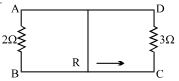
$A$ rectangular loop with a sliding connector of length $10\, cm$ is situated in uniform magnetic field perpendicular to plane of loop. The magnetic induction is $0.1$ tesla and resistance of connector $(R)$ is $1\, ohm$. The sides $AB$ and $CD$ have resistances $2$ $ohm$ and $3$ $ohm$ respectively. Find the current in the connector during its motion with constant velocity one $metre/sec.$
One mole of an ideal gas $(\gamma = 1.4)$ is adiabatically compressed so that its temperature rises from $27\,^oC$ to $35\,^oC$ . The change in the internal energy of the gas is  .... $J$. (given $R = 8.3\,J/mole-K$ )
A particle is executing simple harmonic motion with an amplitude of $0.02$ metre and frequency $50\, Hz$. The maximum acceleration of the particle is