If a body of mass $0.98\, kg$ is made to oscillate on a spring of force constant $4.84\, N/m$, the angular frequency of the body is ..... $ rad/s$
Easy
Download our app for free and get started
$\omega = \sqrt {k/m} = \sqrt {\frac{{4.84}}{{0.98}}} = 2.22\;rad/\sec $

Download our appand get started for free
Experience the future of education. Simply download our apps or reach out to us for more information. Let's shape the future of learning together!No signup needed.*
Similar Questions
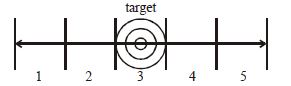
- 1View SolutionA shooting game involves using a gun that fires by itself at random times. The player can only point the gun in a fixed direction while the target moves from side to side with simple harmonic motion, as shown. At which of the given region should the player aim in order to score the greatest number of hits?
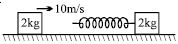
- 2A $2\, Kg$ block moving with $10\, m/s$ strikes a spring of constant $\pi ^2 N/m$ attached to $2\, Kg$ block at rest kept on a smooth floor. The time for which rear moving block remain in contact with spring will be ... $\sec$View Solution
- 3The displacement of a particle is given at time $t$, by:$x=A \sin (-2 \omega t)+B \sin ^2 \omega t \quad$ Then,View Solution
- 4The displacement of a particle is represented by the equation $y = sin^3\,\,\,\omega t$ . The motion isView Solution
- 5A simple pendulum performs simple harmonic motion about $X = 0$ with an amplitude $A$ and time period $T$. The speed of the pendulum at $X = \frac{A}{2}$ will beView Solution
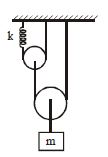
- 6What is the period of small oscillations of the block of mass $m$ if the springs are ideal and pulleys are massless ?View Solution
- 7A flat horizontal board moves up and down under $S.H.M.$ vertically with amplitude $A$. The shortest permissible time period of the vibration such that an object placed on the board may not lose contact with the board is ..........View Solution
- 8If a particle under S.H.M. has time period 0.1 sec and amplitude $2 \times 10^{-3}$. It has maximum velocityView Solution
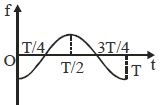
- 9A body is performing simple harmonic motion with amplitude a and time period $T$. Variation of its acceleration $(f)$ with time $(t)$ is shown in figure. If at time $t$, velocity of the body is $v$, which of the following graphs is correctView Solution
- 10$Assertion :$ In simple harmonic motion, the motion is to and fro and periodicView Solution
$Reason :$ Velocity of the particle $(v) = \omega \sqrt {k^2 - x^2}$ (where $x$ is the displacement).