Question
If a charged particle at rest experiences no electromagnetic force:
  1. The electric field must be zero.
  2. The magnetic field must be zero.
  3. The electric field may or may not be zero.
  4. The magnetic field may or may not be zero.
Answer

  1. The electric field must be zero.
  1. The magnetic field may or may not be zero.
Explanation:

Force on charged particle in an electric eld, $\text{F} = \text{qE} \ ...(1)$ 

Force on charged particle in a magnetic eld $\text{F} = \text{q} (\text{v}\times\text{b}) = \text{qvB} \sin\theta \ ...(2) $

Where boldface letter represent vector nature of that quantity, q is charge of the particle, v is the velocity of the particle( if any), and $\theta$ is the angle between velocity and magnetic eld. 

From (1), FE = 0 only when either q = 0 or E = 0. 

Let q ≠ 0, and F ≠ 0, then we must have E ≠ 0 

From (2), if q ≠ 0, v ≠ 0 and B ≠ 0 even then FB can be 'zero' because of θ = 0° or 180°

Need a full question paper?

Generate a complete, print-ready paper with questions like this in minutes — across 16+ boards, with answer keys.

Start Generating Free

Similar questions

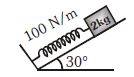
A block of mass $2\,\,kg$ is placed on a rough inclined plane as shown in the figure $(\mu  = 0.2)$ so that it just touches the spring. The block is allowed to move downwards. The spring will be compressed to a maximum of
A space craft of mass $'M' $ and moving with velocity $ 'v' $ suddenly breaks in two pieces of same mass $m$. After the explosion one of the mass $ 'm'$  becomes stationary. What is the velocity of the other part of craft
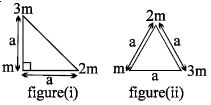
Consider two configurations of a system of three particles of masses $m, 2m$ and $3m.$ The work done by external agent in changing the configuration of the system from figure $(i)$ to figure $(ii)$ is
A particle comes round a circle of radius $1 \,m$ once. The time taken by it is $10 \,sec$. The average velocity of motion is
The dimensions of surface tension are
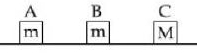
Three blocks $A, B$ and $C$ are lying on a smooth horizontal surface, as shown in the figure. $A$ and $B$ have equal masses, $m$ while $C$ has mass $M$. Block $A$ is given an initial speed $v$ towards $B$ due to which it collides with $B$ perfectly inelastically. The combined mass collides with $C$, also perfectly inelastically. The combined mass collides with $C$, also perfectly inelastically if $\frac{5}{6}^{th}$ of the initial kinetic energy is lost in whole process. What is value of $M/m$ ?
A block of mass $0.1 \,kg$ is held against a wall by applying a horizontal force of $5\, N$ on the block. If the coefficient of friction between the block and the wall is $0.5$, the magnitude of the frictional force acting on the block is ........ $N$
Two satellites of masses $m$ and $3\,m$ revolve around the earth in circular orbits of radii $r$ and $3 r$ respectively. The ratio of orbital speeds of the satellites respectively is :
A moving block having mass $m,$ collides with another stationary block having mass $4\,m$ . The lighter block comes to rest after collision. When the initial velocity of the lighter block is $v,$ then the value of coefficient of restitution $( e)$ will be
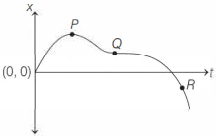
In the following displacement $x$ versus time $t$ graph, at which among the points $P, Q$ and $R$ is the object's speed increasing?