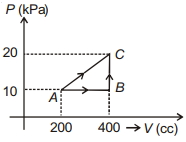
If a gas is taken from $A$ to $C$ through $B$ then heat absorbed by the gas is $8 \,J$. Heat absorbed by the gas in taking it from $A$ to $C$ directly is ............. $J$
Medium
Download our app for free and get started
(b)
When taken through $A B C[\triangle U+$ work $=$ heat absorbed $]$
Heat absorbed $=$ area under graph $+\Delta U=8$
$\Delta U=8-\frac{10 \times 200}{1000}=6$
when taken directly to $C$
$W+\Delta U=Q$
${\left[\frac{10 \times 200}{1000}+\frac{1}{2} \times \frac{2000}{1000}\right]+6=Q \Rightarrow Q=9 \,J }$

Download our appand get started for free
Experience the future of education. Simply download our apps or reach out to us for more information. Let's shape the future of learning together!No signup needed.*
Similar Questions
- 1View SolutionIn the following figures heat is absorbed by the gas
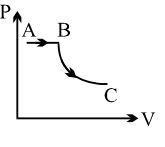
- 2View SolutionA process is shown in the diagram. Which of the following curves may represent the same process ?
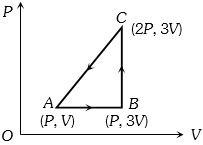
- 3An ideal gas is taken around $ABCA$ as shown in the above $P-V$ diagram. The work done during a cycle isView Solution
- 4View SolutionA gas is being compressed adiabatically. The specific heat of the gas during compression is
- 5$Assertion :$ Air quickly leaking out of a balloon becomes cooler.View Solution
$Reason :$ The leaking air undergoes adiabatic expansion. - 6A piece of hot copper at $100^{\circ} C$ is plunged into a pond at $30^{\circ} C$. The copper cools down to $30^{\circ} C$, while the pond being huge stays at its initial temperature. Then,View Solution
- 7A sample of $1$ mole gas at temperature $\mathrm{T}$ is adiabatically expanded to double its volume. If adiabatic constant for the gas is $\gamma=\frac{3}{2}$, then the work done by the gas in the process is:View Solution
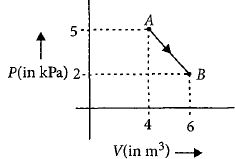
- 8One mole of an ideal diatomic gas undergoes a transition from $A$ to $B$ along a path $AB$ as shown in the figure.View Solution
The change in internal energy of the gas during the transition is ............$\;kJ$
- 9A Carnot engine with sink's temperature at $17\,^oC$ has $50\%$ efficiency. By how much should its source temperature be changed to increases its efficiency to $60\%$ ?...... $K$View Solution
- 10View SolutionEntropy of a thermodynamic system does not change when this system is used for