MCQ
If $A$ is a square matrix such that $A^2 = A$, then $(I + A)^3– 7A$ is equal to:
  • A
    $A$
  • B
    $I - A$
  • $I$
  • D
    $3A$

Answer

Correct option: C.
$I$
Given : $A^2 = A...(i)$
Multiplying both sides by $A, A^3 = A^2= A \ [$From eq. $(i)]...(ii)$
Also given $(I + A)^3 – 7A = I^3+ A^3 + 3I^2A + 3IA^2 – 7A$
Putting $A^2 = A \ [$from eq. $(i)]$ and $A^3 = A \ [$From eq. $(ii)],$
$= I + A + 3IA + 3IA – 7A = I + A + 3A + 3A – 7A \ [\because IA = A]$
$= I + 7A – 7A$
$= I$

Need a full question paper?

Generate a complete, print-ready paper with questions like this in minutes — across 16+ boards, with answer keys.

Start Generating Free

Similar questions

Ratio in which the xy-plane divided the join of (1, 2, 3) and (4, 2, 1) is:
  1. 3 : 1 internally
  2. 3 : 1 externally
  3. 2 : 1 internally
  4. 2 : 1 externally
Let $\sin\text{y}=\text{x}\sin(\text{a}+\text{y}),$ then $\frac{\text{dy}}{\text{dx}}$ is:
  1. $\frac{\sin\text{a}}{\sin\text{a}\sin^2(\text{a}+\text{y})}$
  2. $\frac{\sin^2(\text{a}+\text{y})}{\sin\text{a}}$
  3. $\sin\text{a}\sin^2(\text{a}+\text{y})$
  4. $\frac{\sin^2(\text{a}+\text{y})}{\sin\text{a}}$
$\int\limits^{\infty}_0\log\Big(\text{x}+\frac{1}{\text{x}}\Big)\frac{1}{1+\text{x}^2}\text{ dx}=$
If the function $f(x)=\left\{\begin{array}{cc}\frac{\sin x^2}{x} ; & x \neq 0 \\ 0 ; & x=0\end{array}\right.$, is differentiable at $x=0$, then right hand derivative of $f(x)$ at $x=0$ is
The interval on which the function $f(x) = 2x^3 + 9x^2 + 12x - 1$ is decreasing is:
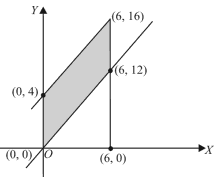
The feasible region for an LPP is shown shaded in the figure. Let $F=3 x-4 y$ be the objective function.
Minimum value of $F$ is
Image
If $\text{f}\text{(x)}=\sqrt{\text{x}^2-10\text{x}+25},$ then the derivative of f(x) in the intereval [0, 7] is:
  1. 1
  2. -1
  3. 0
  4. None of these.
If $\cos\alpha,\cos\beta,\cos\gamma$ are the direction cosines of a vector $\vec{\text{a}}$ then $\cos2\alpha+\cos2\beta+\cos2\gamma$ is equal to:
  1. 2
  2. 3
  3. -1
  4. 0
Ratio in which the xy-plane divided the join of (1, 2, 3) and (4, 2, 1) is:
If the projection of $\vec{\text{a}}=\hat{\text{i}}-2\hat{\text{j}}+3\hat{\text{k}}$ on $\vec{\text{b}}=2\hat{\text{i}}+\lambda\hat{\text{k}}$ is zero, then the value of $\lambda$ is:
  1. $0$
  2. $1$
  3. $\frac{-2}{3}$
  4. $\frac{-3}{2}$