If a piece of metal is heated to temperature $\theta$ and then allowed to cool in a room which is at temperature $\theta_0$, the graph between the temperature $T$ of the metal and time t will be closest to
JEE MAIN 2013, Medium
Download our app for free and get started
According to Newton's $1aw$ of cooling, the temperature goes on decreasing with time non-linearly

Download our appand get started for free
Experience the future of education. Simply download our apps or reach out to us for more information. Let's shape the future of learning together!No signup needed.*
Similar Questions
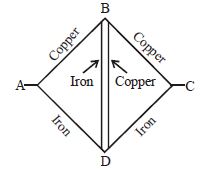
- 1Six wire each of cross-sectional area $A$ and length $l$ are combined as shown in the figure. The thermal conductivities of copper and iron are $K_1$ and $K_2$ respectively. The equivalent thermal resistance between points $A$ and $C$ is :-View Solution
- 2A metal ball of surface area $200\;c{m^2}$ and temperature ${527^o}C$ is surrounded by a vessel at ${27^o}C$. If the emissivity of the metal is $0.4$ , then the rate of loss of heat from the ball is .......... $joules $ approx. $(\sigma = 5.67 \times {10^{ - 8}}J/{m^2}\; - s - {k^4})$View Solution
- 3Consider a compound slab consisting of two different materials having equal thickness and thermal conductivities $ K$ and $2K$ respectively. The equivalent thermal conductivity of the slab isView Solution
- 4If the temperature of the body is increased by $10\% $ , the percentage increase in the emitted radiation will be ....... $\%$View Solution
- 5The maximum energy in thermal radiation from a source occurs at the wavelength $4000Å$ . The effective temperature of the source is ....... $K$View Solution
- 6View SolutionIt is hotter for the same distance over the top of a fire than it is in the side of it, mainly because
- 7A certain stellar body has radius $50 \,R_{s}$ and temperature $2 \,T_{s}$ and is at a distance of $2 \times 10^{10} \,AU$ from the earth. Here, $AU$ refers to the earth-sun distance and $R_{s}$ and $T_{s}$ refer to the sun's radius and temperature, respectively. Take, both star and sun to be ideal black bodies. The ratio of the power received on earth from the stellar body as compared to that received from the sun is close toView Solution
- 8View SolutionFor cooking the food, which of the following type of utensil is most suitable
- 9View SolutionIce formed over lakes has
- 10View SolutionWhile measuring the thermal conductivity of a liquid, we keep the upper part hot and lower part cool, so that