MCQ
If an object is positively charged, theoretically the mass of the object ______?
- AIncreases slightly by a factor of 9.11 × 10⁻³¹kg.
- BDecreases slightly by a factor of 9.11 × 10⁻³¹kg.
- CRemains the same.
- DMay increase or decrease.
Explanation:
If an object is positively charged it loses some of its electrons. The mass of an electron is 9.11 × 10⁻³¹kg. So, if a positively charged body loses ‘n’ number of electrons, it mass decrease by the amount n × 9.11E-31kg.
Generate a complete, print-ready paper with questions like this in minutes — across 16+ boards, with answer keys.
Two electric bulbs A and B are rated as 60 W and 100 W. They are connected in parallel to the same source. Then,
|
(a) Both draw the same current |
|
(b) A draws more current than B |
|
(c) B draws more current than A |
|
(d) Current drawn are in the ratio of their resistances |
An air filled parallel plate capacitor has capacity C. If distance between plates is doubled and it is immersed in a liquid then capacity becomes twice. Dielectric constant of the liquid is
|
(a) 1 |
(b) 2 |
(c) 3 |
(d) 4 |
 energy. The emitted particle is
|
(a) Neutron |
(b) Proton |
(c) α - particle |
(d) Neutrino |
The potential difference across 8 ohm resistance is 48 volt as shown in the figure. The value of potential difference across X and Y points will be
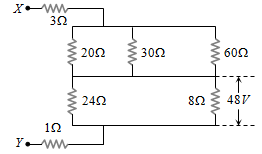
|
(a) 160 volt |
(b) 128 volt |
(c) 80 volt |
(d) 62 volt |
An electron moving with the speed 5  per sec is shooted parallel to the electric field of intensity 1
  . Field is responsible for the retardation of motion of electron. Now evaluate the distance travelled by the electron before coming to rest for an instant (mass of e = 9
  . charge = 1.6
  )
)
|
(a) 7 m |
(b) 0.7 mm |
(c) 7 cm |
(d) 0.7 cm |