MCQ
If body having initial velocity zero is moving with uniform acceleration $8 m / sec ^2$ the distance travelled by it in fifth second will be
  • 36 metres
  • B
    40 metres
  • C
    100 metres
  • D
    Zero

Answer

Correct option: A.
36 metres
(a) Distance travelled in $n^{\text {th }}$ second $=u+\frac{a}{2}(2 n-1)$Distance travelled in $5^{\text {th }}$ second $=0+\frac{8}{2}(2 \times 5-1)=36 \mathrm{~m}$

Need a full question paper?

Generate a complete, print-ready paper with questions like this in minutes — across 16+ boards, with answer keys.
Start Generating Free

Similar questions

Let $n_P$ and $n_e$ be the number of holes and conduction electrons respectively in a semiconductor. Then
If the increase in the kinetic energy of a body is $22 \%$, then the increase in the momentum will be
A galvanometer can be converted into an ammeter by connecting
When two bodies stick together after collision, the collision is said to be
The e.m.f. of a standard cell balances across $150 \mathrm{~cm}$ length of a wire of potentiometer. When a resistance of $2 \Omega$ is connected as a shunt with the cell, the balance point is obtained at $100 \mathrm{~cm}$. The internal resistance of the cell is
The amplitude of a particle executing SHM is made three-fourth keeping its time period constant. Its total energy will be
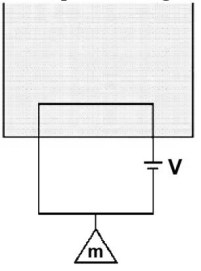
A massless square loop, of wire of resistance $10\,\Omega$. supporting a mass of $1\,g$. hangs vertically with one of its sides in a uniform magnetic field of $10^3\, G$, directed outwards in the shaded region. A dc voltage $V$ is applied to the loop. For what value of V. the magnetic force will exactly balance the weight of the supporting mass of $1\,g$ ? (If sides of the loop $=10\,cm , g =10\,ms ^{-2}$ )
A mass of $20 \mathrm{~kg}$ moving with a speed of $10 \mathrm{~m} / \mathrm{s}$ collides with another stationary mass of $5 \mathrm{~kg}$. As a result of the collision, the two masses stick together. The kinetic energy of the composite mass will be
Hubble's law states that the velocity with which milky way is moving away from the earth is proportional to
In a cyclotron experiment, if we assume that maximum radius attained by any charged particle is equal to radius of dees, then minimum kinetic energy gained by the particles will be for