MCQ
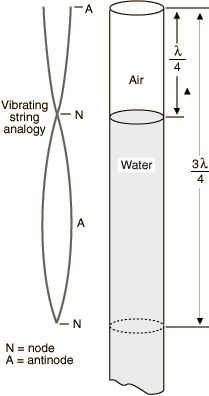
If $l_1$ and $l_2$ are the lengths of air column for the first and second resonance when a tuning fork of frequency $n$ is sounded on a resonance tube, then the distance of the displacement antinode from the top end of the resonance tube is:
  • A
    $2\left( {{l_2} - {l_1}} \right)$
  • B
    $\frac{1}{2}\left( {{2l_{2  }}-{l_1}} \right)$
  • $\frac{{{l_2} - 3{l_1}}}{2}$
  • D
    $\frac{{{l_2} - {l_1}}}{2}$

Answer

Correct option: C.
$\frac{{{l_2} - 3{l_1}}}{2}$
c
If $l_{1}=\frac{\lambda}{4},$ and $l_{2}=\frac{3 \lambda}{4},$ and according to the image, displacement anti node from the top should be zero,

therefore,

distance $=\left(l_{2}-3 l_{1}\right) / 2=0$

answer $C$ is correct.

Need a full question paper?

Generate a complete, print-ready paper with questions like this in minutes — across 16+ boards, with answer keys.

Start Generating Free

Similar questions

The potential energy of a weight less spring compressed by a distance $ a $ is proportional to
Four identical rods are stretched by same force. Maximum extension is produced in
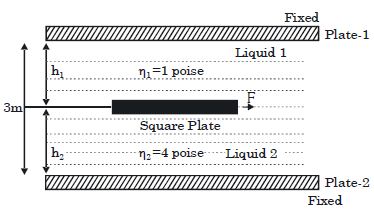
A thin square plate of side $2\ m$ is moving at the interface of two very viscous liquids of viscosities ${\eta _1} = 1$ poise and ${\eta _2} = 4$ poise respectively as shown in the figure. Assume a linear velocity distribution in each fluid. The liquids are contained between two fixed plates. $h_1 + h_2 = 3\ m$ . A force $F$ is required to move the square plate with uniform velocity $10\ m/s$ horizontally then the value of minimum applied force will be ........ $N$
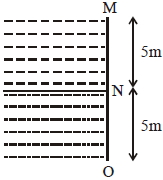
Two liquids of densities $\rho_{1}$ and $\rho_{2}\left(\rho_{2}=2 \rho_{1}\right)$ are filled up behind a square wall of side $10\; \mathrm{m}$ as shown in figure. Each liquid has a height of $5 \;\mathrm{m} .$ The ratio of the forces due to these liquids exerted on upper part $MN$ to that at the lower pait $NO$ is (Assume that the liquids are not mixing)
A force of $(3\hat i + 4\hat j)\, N$ acts on a body and displaces it by $(3\hat i + 4\hat j)\,m$ . The work done by the force is ............. $\mathrm{J}$
Dimensions of potential energy are
A particle moving in a circle of radius $R$ with uniform speed takes time $\mathrm{T}$ to complete one revolution. If this particle is projected with the same speed at an angle $\theta$ to the horizontal, the maximum height attained by it is equal to $4 R$. The angle of projection $\theta$ is then given by :
If $g$ is the acceleration due to gravity on the earth's surface, the gain in the potential energy of an object of mass $m$ raised from the surface of earth to a height equal to the radius $R$ of the earth is:
A man of weight $80\, kg$ is standing in an elevator which is moving with an acceleration of $6\,\,m/{s^2}$ in upward direction. The apparent weight of the man will be  ......... $N$ $(g = 10\,m/{s^2})$
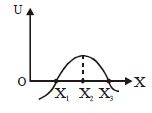
In the figure shown the potential energy $(U)$ of a particle is plotted against its position $'x'$ from origin. The particle at