Question
If $ \log_{10} 8 = 0.90;$ find the value of : $\log\sqrt{32}$

Answer

Given that $\log _{10} 8=0.90$
$ \Rightarrow \log _{10} 2 \times 2 \times 2=0.90$
$ \Rightarrow \log _{10} 2^3=0.90$
$ \Rightarrow 3 \log _{10} 2=0.90$
$ \Rightarrow \log _{10} 2=\frac{0.90}{3}$
$\Rightarrow \log _{10} 2=0.30\ldots(1)$
$ \log \sqrt{32}$
$ =\log _{10}(32)^{\frac{1}{2}}$
$ =\frac{1}{2} \log _{10}(32)$
$ =\frac{1}{2} \log _{10}(2 \times 2 \times 2 \times 2 \times 2)$
$ =\frac{1}{2} \log _{10}\left(2^5\right)$
$ =\frac{1}{2} \times 5 \log _{10} 2$
$=\frac{1}{2} \times 5(0.30)$
$[$from$(1)]$
$ =5 \times 0.15$
$ =0.75$

Need a full question paper?

Generate a complete, print-ready paper with questions like this in minutes — across 16+ boards, with answer keys.
Start Generating Free

Similar questions

Image
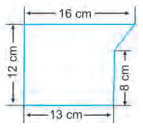
The cross-section of a piece of metal 2 m in length is shown in the adjoining figure.
Calculate : (i) the area of its cross-section;
(ii) the volume of piece of metal;
(iii) the weight of piece of metal to the nearest kg, if 1 $cm ^3$ of the metal weighs 6.5 g.
If $\frac{x^2+1}{x}=3 \frac{1}{3}$ and $\mathrm{x}>1 ;$ Find If $x^3-\frac{1}{x^3}$
Construct a parallelogram $\text{ABCD},$ when:$AB = 5.8 \ cm,$ diagonal $AC = 8.2 \ cm$ and diagonal $BD = 6.2 \ cm.$
Solve the following equations for the unknown: $(a + 2)(2a +5) = 2(a + 1)^2+ 13$
In $\triangle ABC; \angle ABC = 90^\circ , \angle CAB = x^\circ , \tan x^\circ = \frac{3}{4}$ and $BC = 15 \ cm.$ Find the measures of $AB$ and $AC.$
Solve graphically the simultaneous equations given below. Take the scale as $2 \ cm = 1$ unit onboth the axes.$x - 2y - 4 = 0;2x + y = 3$
Factorise the following:$2a^3 + 5a^2b - 12ab^2$
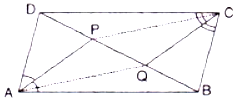
In the given figure, $A P$ is the bisector of $\angle A$ and $C Q$ is the bisector of $\angle C$ of parallelogram $\text{ABCD}$.
Prove that $\text{APCQ}$ is a parallelogram.
Evaluate the following:$\frac{5 \cot 5^{\circ} \cot 15^{\circ} \cot 25^{\circ} \cot 35^{\circ} \cot 45^{\circ}}{7 \tan 45^{\circ} \tan 55^{\circ} \tan 65^{\circ} \tan 75^{\circ} \tan 85^{\circ}}+\frac{2 \operatorname{cosec} 12^{\circ} \operatorname{cosec} 24^{\circ} \cos 78^{\circ} \cos 66^{\circ}}{7 \sin 14^{\circ} \sin 23^{\circ} \sec 76^{\circ} \sec 67^{\circ}}$
Make $R$ the subject of formula $A=P\left(1+\frac{R}{100}\right)^N$