If ${\mu _s},\,{\mu _k}$ and ${\mu _r}$ are coefficients of static friction, sliding friction and rolling friction, then
Easy


Download our appand get started for free
Experience the future of education. Simply download our apps or reach out to us for more information. Let's shape the future of learning together!No signup needed.*
Similar Questions
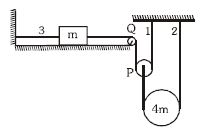
- 1Shown in the diagram is a system of two bodies, a block of mass $m$ and a disc of mass $4\ m$ , held in equilibrium. If the string $3$ is burnt, find the acceleration of the disc. Neglect the masses of the pulleys $P$ and $Q$ . The co-efficient of friction between the block and horizontal surface is $0.5$ and friction between disc and string is zero ........ $m/s^2$View Solution
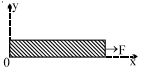
- 2A uniform rod of length $L$ and mass $M$ has been placed on a rough horizontal surface. The horizontal force $F$ applied on the rod is such that the rod is just in the state of rest. If the coefficient of friction varies according to the relation $\mu = Kx$ where $K$ is a $+$ ve constant. Then the tension at mid point of rod isView Solution
- 3A block $A$ of mass $m_1$ rests on a horizontal table. A light string connected to it passes over a frictionless pully at the edge of table and from its other end another block $B$ of mass $m_2$ is suspended. The coefficient of kinetic friction between the block and the table is $\mu _k.$ When the block $A$ is sliding on the table, the tension in the string isView Solution
- 4View SolutionA body is revolving with a constant speed along a circle. If its direction of motion is reversed but the speed remains the same, then which of the following statement is true
- 5A body of mass $1\, kg$ tied to one end of string is revolved in a horizontal circle of radius $0.1\, m$ with a speed of $3$ revolution/sec, assuming the effect of gravity is negligible, then linear velocity, acceleration and tension in the string will beView Solution
- 6View SolutionA car is moving with high velocity when it has a turn. A force acts on it outwardly because of
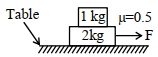
- 7The coefficient of static friction between two blocks is $0.5$ and the table is smooth. The maximum horizontal force that can be applied to move the blocks together is $\ldots \ldots . N$. (take $\left.g=10\, {ms}^{-2}\right)$View Solution
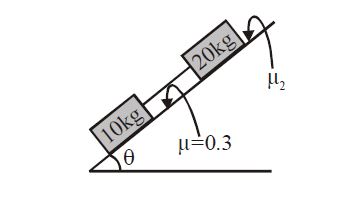
- 8Value of $\theta$ is increased gradually from $\theta = 0$ At $\theta=tan^{-1}(\frac{1}{2})$ both the block just start slipping. Then value of $\mu_2$ is : $(g = 10 m/s^2)$View Solution
- 9A body is sliding down an inclined plane (angle of inclination $45^o$). If the coefficient of friction is $0.5$ and $g = 9.8\, m/s^2$. then the acceleration of the body downwards in $m/s^2$ isView Solution
- 10A car of mass $800 \,kg$ moves on a circular track of radius $40\, m$. If the coefficient of friction is $0.5$, then maximum velocity with which the car can move is ......... $m/s$View Solution