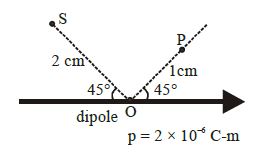
If $OP = 1\,\,cm$ and $OS = 2\,\, cm$, work done by electric field in shifting a point charge $\frac {4\sqrt 2}{27}\,\, μC$ from point $P$ to $S$ in given figure is
Medium


Download our appand get started for free
Experience the future of education. Simply download our apps or reach out to us for more information. Let's shape the future of learning together!No signup needed.*
Similar Questions
- 1A force $F$ acts between sodium and chlorine ions of salt (sodium chloride) when put $1\,cm$ apart in air. The permittivity of air and dielectric constant of water are ${\varepsilon _0}$ and $K$ respectively. When a piece of salt is put in water electrical force acting between sodium and chlorine ions $1\,cm$ apart isView Solution
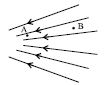
- 2Which of the following is true for the figure showing electric lines of force? ($E$ is electrical field, $V$ is potential)View Solution
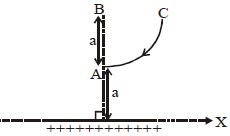
- 3For an infinite line of charge having charge density $\lambda $ lying along $x-$ axis, the work required in moving charge $q$ from $C$ to $A$ along arc $CA$ is :-View Solution
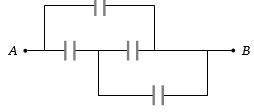
- 4In the circuit shown in figure, each capacitor has a capacity of $3\,\mu F$. The equivalent capacity between $A$ and $B$ is.......$\mu F$View Solution
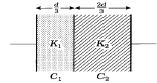
- 5A parallel plate capacitor with air between the plates has capacitance of $9\ pF$. The separation between its plates is '$d$'. The space between the plates is now filled with two dielectrics. One of the dielectrics has dielectric constant $k_1 = 3$ and thickness $\frac{d}{3}$ while the other one has dielectric constant $k_2 = 6$ and thickness $\frac{2d}{3}$ . Capacitance of the capacitor is now.......$pF$View Solution
- 6A parallel plate capacitor is charged to a potential difference of $50\, V$. It is discharged through a resistance. After $1$ second, the potential difference between plates becomes $40 \,V$. ThenView Solution
- 7An electric dipole moment $\vec p = (2.0\hat i + 3.0\hat j)$ $\mu C. $ $m$ is placed in a uniform electric field $\vec E = (3.0\hat i + 2.0\hat k)$ $×$$10^5$ $N$ $C^{-1}$.View Solution
- 8A particle of mass $‘m’$ and charge $‘q’$ is accelerated through a potential difference of $V$ volt, its energy will beView Solution
- 9Two metal spheres of capacitance ${C_1}$ and ${C_2}$ carry some charges. They are put in contact and then separated. The final charges ${Q_1}$ and ${Q_2}$ on them will satisfyView Solution
- 10View SolutionOn increasing the plate separation of a charged condenser, the energy