MCQ
If $\overrightarrow P .\overrightarrow Q = PQ,$ then angle between $\overrightarrow P $and $\overrightarrow Q $ is ....... $^o$
  • $0$
  • B
    $30$
  • C
    $45$
  • D
    $60$

Answer

Correct option: A.
$0$
a
(a) $\cos \theta = \frac{{\vec P.\vec Q}}{{PQ}} = 1$ 

$\theta = 0^\circ $

Need a full question paper?

Generate a complete, print-ready paper with questions like this in minutes — across 16+ boards, with answer keys.

Start Generating Free

Similar questions

If one takes into account finite mass of the proton, then the correction to the binding energy of the hydrogen atom is approximately (take, mass of proton $=1.60 \times 10^{-27} \,kg$ and mass of electron $\left.=9.10 \times 10^{-31} \,kg \right)$
A device used to measure very high temperature is
If the refractive index of the material of a prism is $\cot \left(\frac{A}{2}\right)$, where $A$ is the angle of prism then the angle of minimum deviation will be
Which of the following is the altitude-time graph for a projectile thrown horizontally from the top of the tower
The potential energy of a particle of mass $m$ at a distance $r$ from a fixed point $O$ is given by $\mathrm{V}(\mathrm{r})=\mathrm{kr}^2 / 2$, where $\mathrm{k}$ is a positive constant of appropriate dimensions. This particle is moving in a circular orbit of radius $\mathrm{R}$ about the point $\mathrm{O}$. If $\mathrm{v}$ is the speed of the particle and $\mathrm{L}$ is the magnitude of its angular momentum about $\mathrm{O}$, which of the following statements is (are) true?

$(A)$ $v=\sqrt{\frac{k}{2 m}} R$

$(B)$ $v=\sqrt{\frac{k}{m}} R$

$(C)$ $\mathrm{L}=\sqrt{\mathrm{mk}} \mathrm{R}^2$

$(D)$ $\mathrm{L}=\sqrt{\frac{\mathrm{mk}}{2}} \mathrm{R}^2$
The net applied force on a body in uniform circular motion should always be
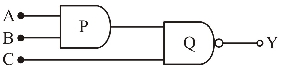
What is the output $Y$ in the following circuit, when all the three inputs $A,\, B,\, C$ are first $0$ and then $1$ ?
A block of mass $m$ slides down the plane inclined at angle $30^{\circ}$ with an acceleration $\frac{ g }{4}$. The value of coefficient of kinetic friction will be :
An object is placed infront of a convex mirror at a distance of $50\, cm$. A plane mirror is introduced covering the lower half of the convex mirror. If the distance between the object and plane mirror is $30\, cm$, it is found that there is no parallax between the images formed by two mirrors. magnification of convex mirror will be......
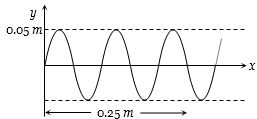
If the speed of the wave shown in the figure is $330m/s$ in the given medium, then the equation of the wave propagating in the positive $x-$direction will be (all quantities are in $M.K.S.$ units)