MCQ
If $R$ and $H$ are the horizontal range and maximum height attained by a projectile, than its speed of projection is ..........
  • A
    $\sqrt{2 g R+\frac{4 R^2}{g H}}$
  • $\sqrt{2 g H+\frac{R^2 g}{8 H}}$
  • C
    $\sqrt{2 g H+\frac{8 H}{R g}}$
  • D
    $\sqrt{2 g H+\frac{R^2}{H}}$

Answer

Correct option: B.
$\sqrt{2 g H+\frac{R^2 g}{8 H}}$
b
(b)

$H=\frac{u^2 \sin ^2 \theta}{2 g} \Rightarrow \sin \theta=\sqrt{\frac{2 g H}{u^2}}$

$R=\frac{2 u^2 \sin \theta \cos \theta}{g}$

$R=\frac{2 u^2}{g} \sqrt{\frac{2 g H}{u^2}} \times \sqrt{1-\frac{2 g H}{u^2}}$

$R=\frac{2 u^2}{g} \sqrt{\frac{2 g H}{u^2}} \times \sqrt{\frac{u^2-2 g H}{u^2}}$

$\frac{g R}{2 \sqrt{2 g H}}=\sqrt{u^2-2 g H}$

Squaring both the sides,

$\frac{g R^2}{4 \times 2 g H}=u^2-2 g H$

$\Rightarrow u^2=2 g H+\frac{9 R^2}{8 H}$

$u=\sqrt{2 g H+\frac{g R^2}{8 H}}$
Need a full question paper?

Generate a complete, print-ready paper with questions like this in minutes — across 16+ boards, with answer keys.

Start Generating Free

Similar questions

Two particles are in $SHM$ on same straight line with amplitude $A$ and $2A$ and with same angular frequency $\omega .$ It is observed that when first particle is at a distance $A/\sqrt{2}$ from origin and going toward mean position, other particle is at extreme position on other side of mean position. Find phase difference between the two particles
Match List$-I$ with List$-II$

      List $-I$       List $-II$
$(A)$ Moment of inertia of solid sphere of radius $(R)$ about any tangent  $(I)$  $\frac{5}{3} MR ^{2}$
$(B)$ Moment of inertia of hollow sphere of radius $(R)$ about any tangent $(II)$ $\frac{7}{5} MR ^{2}$
$(C)$ Moment of inertia of circular ring of radius $(R)$ about its diameter. $(III)$ $\frac{1}{4} MR ^{2}$
$(D)$ Moment of inertia of circular disc of radius $(R)$ about any diameter. $(IV)$ $\frac{1}{2} MR ^{2}$

Question: Choose the correct answer from the options given below

A particle is projected upwards. The times corresponding to height $h$ while ascending and while descending are $t‌‌_1$ and $t_2$ respectively. The velocity of projection will be
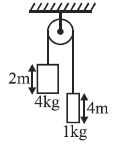
In figure shown, both blocks are released from rest. Find the time to cross each other ? ......... $\sec$
A particle travels $10\,m$ in first $5\, sec$ and $10\,m$ in next $3 \,sec$. Assuming constant acceleration what is the distance travelled in next $2 \,sec$..........$m$
A soap film of surface tension $3 \times {10^{ - 2}}\,N{m^{ - 1}}$ formed in rectangular frame, can support a straw. The length of the film is $10\, cm$. Mass of the straw the film can support is ........ $gm$
Two forces $3\,N$ and $2\, N$ are at an angle $\theta$ such that the resultant is $R$. The first force is now increased to $ 6\,N$ and the resultant become $2R$. The value of is ....... $^o$
The minimum force required to start pushing a body up a rough (frictional coefficient $\mu$) inclined plane is $F _{1}$ while the minimum force needed to prevent it from sliding down is $F _{2}$. If the inclined plane makes an angle $\theta$ from the horizontal such that $\tan \theta=2 \mu$, then the ratio $\frac{F_{1}}{F_{2}}$ is
In adiabatic expansion
An object of mass $m$ is sliding down a hill of arbitrary shape and after traveling a certain horizontal path stops because of friction. The friction coefficient is different for different segments of the entire path but it is independent of the velocity and direction of motion. The work done that a force must perform to return the object  its initial position along the same path would be :-