MCQ
If $R , X _{ L }$. and $X _{ C }$ represent resistance, inductive reactance and capacitive reactance. Then which of the following is dimensionless:
  • A
    $RX _{ L } X _{ C }$
  • $\frac{ R }{\sqrt{ X _{ L } X _{ C }}}$
  • C
    $\frac{R}{X_L X_C}$
  • D
    $R \frac{X_L}{X_C}$

Answer

Correct option: B.
$\frac{ R }{\sqrt{ X _{ L } X _{ C }}}$
b
All three have same dimension therefore $\frac{ R }{\sqrt{X_L X_C}}$ is dimensionless.

Need a full question paper?

Generate a complete, print-ready paper with questions like this in minutes — across 16+ boards, with answer keys.

Start Generating Free

Similar questions

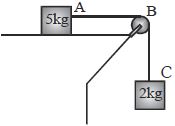
A trolley of mass $5\,kg$ on a horizontal smooth surface is pulled by a load of mass $2\,kg$ by means of uniform rope $ABC$ of length $2\,m$ and mass $ 1\,kg.$ As the load falls from $BC = 0$ to $BC = 2\,m,$ its acceleration in $m/s^2$ changes from
Given below are two statements: one is labelled as Assertion $A$ and the other is labelled as Reason $R$.

Assertion $A:$ A pendulum clock when taken to Mount Everest becomes fast.

Reason $R:$ The value of $g$ (acceleration due to gravity) is less at Mount Everest than its value on the surface of earth.

In the light of the above statements, choose the most appropriate answer from the options given below

For a particle in a non-uniform accelerated circular motion
If a man pushes a wall and is unable to displace it, he:
At nodes in stationary waves:
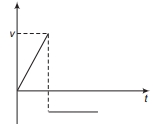
The velocity-time graph for a particle moving along $x$-axis is shown in the figure. The corresponding displacement-time graph is correctly shown by
An aeroplane moving horizontally at a speed of $200\;m/s$ and at a height of $8\;km$ is to drop a bomb on a target. At what horizontal distance from the target should the bomb be released..........$km$
A small particle elastically strikes a fixed smooth sphere of $4\,cm$ radius, with a speed of $5\,m/s$. The impact parameter for the collision is $2\sqrt {3\,} \,cm$ . Calculate the angle of deflection of the particle ............... $^o$
Mechanical equivalent of heat is equal to the amount of:
A gas kept in a container of finite conductivity is suddenly compressed. The process:
  1. Must be very nearly adiabatic.
  2. Must be very nearly isothermal.
  3. May be very nearly adiabatic.
  4. May be very nearly isothermal.