A condenser of capacity $50\,\mu F$ is charged to $10\;volts$. Its energy is equal to
Easy
Download our app for free and get started
(a) $U = \frac{1}{2}C{V^2} = \frac{1}{2} \times 50 \times {10^{ - 6}} \times {(10)^2} = 2.5 \times {10^{ - 3}}J$

Download our appand get started for free
Experience the future of education. Simply download our apps or reach out to us for more information. Let's shape the future of learning together!No signup needed.*
Similar Questions
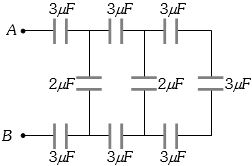
- 1The resultant capacitance between $A$ and $B$ in the following figure is equal to.....$\mu F$View Solution
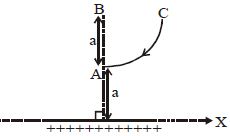
- 2For an infinite line of charge having charge density $\lambda $ lying along $x-$ axis, the work required in moving charge $q$ from $C$ to $A$ along arc $CA$ is :-View Solution
- 3A charge of $5\,C$ is given a displacement of $0.5\,m$. The work done in the process is $10\,J$. The potential difference between the two points will be.......$V$View Solution
- 4At a distance $l$ from a uniformly charged long wire, a charged particle is thrown radially outward with a velocity $u$ in the direction perpendicular to the wire. When the particle reaches a distance $2 l$ from the wire, its speed is found to be $\sqrt{2} u$. The magnitude of the velocity, when it is a distance $4 l$ away from the wire is (ignore gravity)View Solution
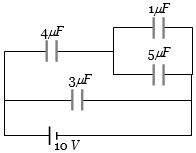
- 5The charge on $4\, \mu F$ capacitor in the given circuit is .... in $\mu C$View Solution
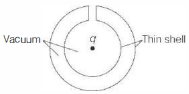
- 6A positive charge $q$ is placed at the centre of a neutral hollow cylindrical conducting shell with its cross-section as shown in the figure below. Which one of the following figures correctly indicates the induced charge distribution on the conductor? (Ignore edge effects)View Solution
- 7Twenty seven drops of same size are charged at $220\, \mathrm{~V}$ each. They combine to form a bigger drop. Calculate the potential of the bigger drop. (In $\mathrm{~V}$)View Solution
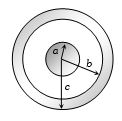
- 8A solid conducting sphere of radius $a$ has a net positive charge $2Q$. A conducting spherical shell of inner radius $b$ and outer radius $c$ is concentric with the solid sphere and has a net charge $-Q$. The surface charge density on the inner and outer surfaces of the spherical shell will beView Solution
- 9View SolutionAssertion: Electron move away from a region of higher potential to a region of lower potential.
Reason: An electron has a negative charge.
- 10A hollow metal sphere of radius $5\, cm$ is charged so that the potential on its surface is $10\, V$. The potential at the centre of the sphere isView Solution