A condenser of capacitance $10\,\mu F$ has been charged to $100\,volts$. It is now connected to another uncharged condenser in parallel. The common potential becomes $40\,volts$. The capacitance of another condenser is......$\mu F$
Medium
Download our app for free and get started
(a) By using $V = \frac{{{C_1}{V_1} + {C_2}{V_2}}}{{{C_1} + {C_2}}}$
$==>$ $40 = \frac{{10 \times 100 + {C_2} \times 0}}{{10 + {C_2}}}$ $==>$ ${C_2} = 15\,\mu F$
$==>$ $40 = \frac{{10 \times 100 + {C_2} \times 0}}{{10 + {C_2}}}$ $==>$ ${C_2} = 15\,\mu F$

Download our appand get started for free
Experience the future of education. Simply download our apps or reach out to us for more information. Let's shape the future of learning together!No signup needed.*
Similar Questions
- 1Three capacitors $2$ $\mu F$, $3$ $\mu F$ and $5$ $\mu F$ can withstand voltages to $3\,V, 2\,V$ and $1\,V$ respectively. Their series combination can withstand a maximum voltage equal to.....$Volts$View Solution
- 2A charge of $10\, e.s.u.$ is placed at a distance of $2\, cm$ from a charge of $40\, e.s.u.$ and $4\, cm$ from another charge of $20\, e.s.u.$ The potential energy of the charge $10\, e.s.u.$ is (in $ergs$)View Solution
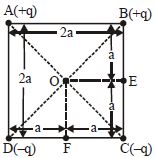
- 3The ratio of electric potentials at the point $E$ to that at the point $F$ isView Solution
- 4Assume that an electric field $\vec E = 30{x^2}\hat i$ exists in space. Then the potential difference $V_A-V_O$ where $V_O$ is the potential at the origin and $V_A$ the potential at $x = 2\ m$ is....$V$View Solution
- 5A $400\, pF$ capacitor is charged with a $100\, V$ battery. After disconnecting battery this capacitor is connected with another $400\, pF$ capacitor. Then find out energy loss.View Solution
- 6Two uniformly charged spherical conductors $A$ and $B$ of radii $5 mm$ and $10 mm$ are separated by a distance of $2 cm$. If the spheres are connected by a conducting wire, then in equilibrium condition, the ratio of the magnitudes of the electric fields at the surface of the sphere $A$ and $B$ will be .View Solution
- 7A parallel plate capacitor has plates of area $A$ separated by distance $d$ between them. It is filled with a dielectric which has a dielectric constant that varies as $\mathrm{k}(\mathrm{x})=\mathrm{K}(1+\alpha \mathrm{x})$ where $\mathrm{x}$ is the distance measured from one of the plates. If $(\alpha \text {d)}<<1,$ the total capacitance of the system is best given by the expressionView Solution
- 8Two capacitors of capacitance $2C$ and $C$ are joined in parallel and charged to potential $V$. The battery is now removed and the capacitor $C$ is filled with a medium of dielectric constant $K$. The potential difference across each capacitor will beView Solution
- 9In one design of capacitor thin sheets ot metal of area $80\ mm \times 80\ mm$ sandwich between them a piece of paper whose thickness is $40\ μm$. The relative permittivity of the paper is $4.0$ and its dielectric strength is $20\ MVm^{-1}$. Calculate the maximum charge that can be put on the capacitorView Solution
[permittivity of free space $ = 9 \times 10^{-12}\ Fm^{-1}$]
- 10A neutral spherical copper particle has a radius of $10 \,nm \left(1 \,nm =10^{-9} \,m \right)$. It gets charged by applying the voltage slowly adding one electron at a time. Then, the graph of the total charge on the particle versus the applied voltage would look likeView Solution