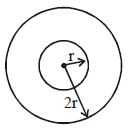
If the distance between the plates of parallel plate capacitor is halved and the dielectric constant of dielectric is doubled, then its capacity will
Easy


Download our appand get started for free
Experience the future of education. Simply download our apps or reach out to us for more information. Let's shape the future of learning together!No signup needed.*
Similar Questions
- 1A capacitor is connected to a battery of voltage $V$. Now a di electric slab of dielectric constant $k$ is completely inserted between the plates, then the final charge on the capacitor will beView Solution
(If initial charge is $q_{0}$ )
- 2Two equal charges $q$ of opposite sign separated by a distance $2a$ constitute an electric dipole of dipole moment $p$. If $P$ is a point at a distance $r$ from the centre of the dipole and the line joining the centre of the dipole to this point makes an angle $\theta $ with the axis of the dipole, then the potential at $P$ is given by $(r > > 2a)$ (Where $p = 2qa$)View Solution
- 3View SolutionAn insulator plate is passed between the plates of a capacitor. Then the displacement current
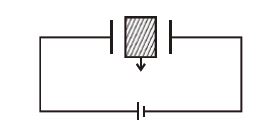
- 4Two point charges $-Q$ and $+Q / \sqrt{3}$ are placed in the xy-plane at the origin $(0,0)$ and a point $(2,0)$, respectively, as shown in the figure. This results in an equipotential circle of radius $R$ and potential $V =0$ in the $xy$-plane with its center at $(b, 0)$. All lengths are measured in meters.View Solution
($1$) The value of $R$ is. . . . meter.
($2$) The value of $b$ is. . . . . .meter.
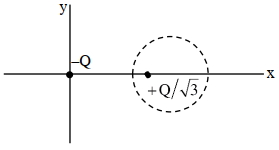
- 5A $2\, \mu F$ capacitor $C _{1}$ is first charged to a potential difference of $10\, V$ using a battery.Then the battery is removed and the capacitor is connected to an uncharged capacitor $C _{2}$ of $8\, \mu F$. The charge in $C _{2}$ on equilibrium condition is $\ldots\,\mu C$. (Round off to the Nearest Integer)View Solution
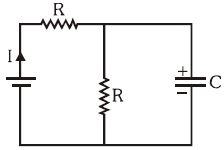
- 6In the given figure initially the capacitor is uncharged. Ratio of current at $t = 0$ & $t = \infty$ will beView Solution
- 7View SolutionDielectric constant for metal is
- 8View SolutionWhich of the following is possible application of an RC circuit?
- 9A particle of mass $‘m’$ and charge $‘q’$ is accelerated through a potential difference of $V$ volt, its energy will beView Solution
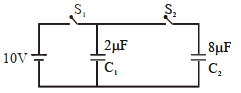
- 10If the potential of the inner shell is $10\,V$ and that of the outer shell is $5\,V$, then potential at the centre will be....$V$View Solution