If the normal force is doubled, the coefficient of friction is
Easy


Download our appand get started for free
Experience the future of education. Simply download our apps or reach out to us for more information. Let's shape the future of learning together!No signup needed.*
Similar Questions
- 1View SolutionA car travels north with a uniform velocity. It goes over a piece of mud which sticks to the tyre. The particles of the mud, as it leaves the ground are thrown
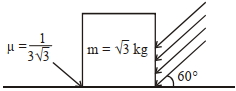
- 2As shown in the figure, a block of mass $\sqrt{3}\, kg$ is kept on a horizontal rough surface of coefficient of friction $\frac{1}{3 \sqrt{3}}$. The critical force to be applied on the vertical surface as shown at an angle $60^{\circ}$ with horizontal such that it does not move, will be $3 x$. The value of $3x$ will beView Solution
$\left[ g =10 m / s ^{2} ; \sin 60^{\circ}=\frac{\sqrt{3}}{2} ; \cos 60^{\circ}=\frac{1}{2}\right]$
- 3A block is projected upwards on an inclined plane of inclination $37^o$ along the line of greatest slope of $\mu = 0.5$ with velocity of $5 m/s$. The block $1^{st}$ stops at $a$ distance of .......... $m$ from starting pointView Solution
- 4A body of mass $10\, kg$ is lying on a rough plane inclined at an angle of $30^o$ to the horizontal and the coefficient of friction is $0.5$. the minimum force required to pull the body up the plane is ........ $N$View Solution
- 5A body of mass $10$ kg slides along a rough horizontal surface. The coefficient of friction is $1/\sqrt 3 $. Taking $g = 10\,m/{s^2}$, the least force which acts at an angle of $30^o $ to the horizontal is ...... $N$View Solution
- 6Radius of the curved road on national highway is $R$. Width of the road is $b$. The outer edge of the road is raised by $h$ with respect to inner edge so that a car with velocity $v$ can pass safe over it. The value of $h$ isView Solution
- 7A body of mass $100\, g$ is sliding from an inclined plane of inclination $30^°$. What is the frictional force experienced if $\mu = 1.7$View Solution
- 8Abody is placed on a rough inclined plane of inclination $\theta$ .As the angle $\theta$ is increased from $0^o$ to $90^o$ the contact force between the block and the planeView Solution
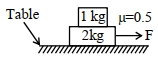
- 9The coefficient of static friction between two blocks is $0.5$ and the table is smooth. The maximum horizontal force that can be applied to move the blocks together is $\ldots \ldots . N$. (take $\left.g=10\, {ms}^{-2}\right)$View Solution
- 10An inclined plane is bent in such a way that the vertical cross-section is given by $y =\frac{ x ^{2}}{4}$ where $y$ is in vertical and $x$ in horizontal direction. If the upper surface of this curved plane is rough with coefficient of friction $\mu=0.5,$ the maximum height in $cm$ at which a stationary block will not slip downward is............$cm$View Solution