A circular disc of radius 'R' is placed co-axially and horizontally inside an opaque hemispherical bowl of radius 'a' (Fig). The far edge of the disc is just visible when viewed from the edge of the bowl. The bowl is filled with transparent liquid of refractive index μ and the near edge of the disc becomes just visible. How far below the top of the bowl is the disc placed?
Download our app for free and get started
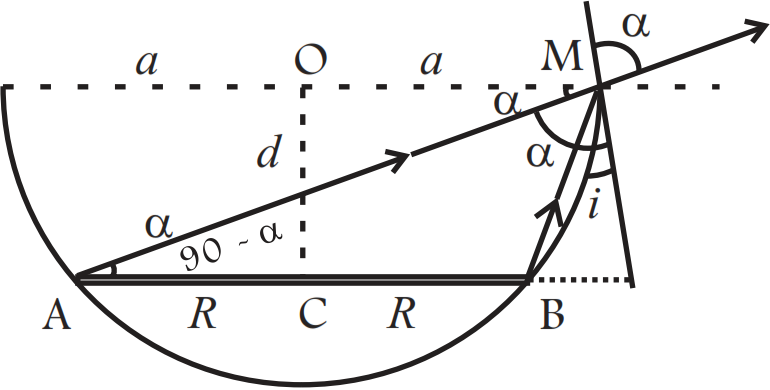
From the given figure, we have
AM is the direction of incidence ray before liquid is filled. After filling the bowl with the liduid, BM is the direction of the incidnet ray, Refracted ray in both cases is same as that along AM.
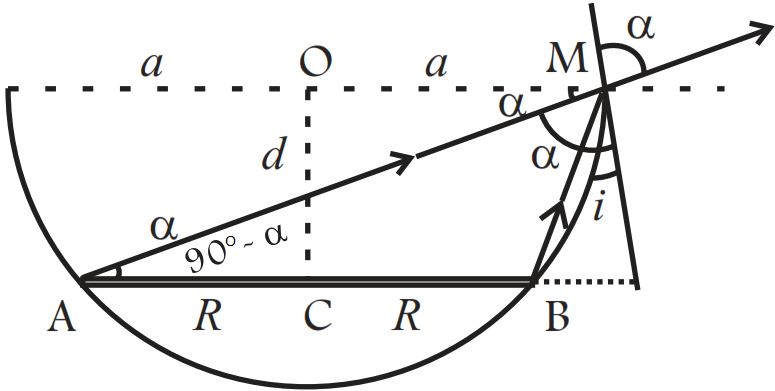
Let the disc is separated by O at a distance d as shown in figure.
From the figure, we have
N = 90º, OM = a, CB = NB = a - R, AN = a + R
Now, $\sin\text{t}=\frac{\text{a}-\text{R}}{\sqrt{\text{d}^2+(\text{a}-\text{R})^2}}\text{ and }\sin\alpha=\cos(90^\circ-\alpha)=\frac{\text{a}+\text{R}}{\sqrt{\text{d}^2+(\text{a}-\text{R})^2}}$
According to Snell's law we, have
$\frac{1}{\mu}=\frac{\sin\text{i}}{\sin\text{r}}=\frac{\sin\text{i}}{\sin\alpha}$
Substituting $\sin\text{i}=\frac{\text{a}-\text{R}}{\sqrt{\text{d}^2+(\text{a}-\text{R})^2}}\text{ and }\sin\alpha=\frac{\text{a}+\text{R}}{\sqrt{\text{d}^2+(\text{a}-\text{R})^2}}$, we get
$\text{d}=\frac{\mu(\text{a}^2-\text{R}^2)}{\sqrt{(\text{a}+\text{R})^2-\mu(\text{a}-\text{R})^2}}$
AM is the direction of incidence ray before liquid is filled. After filling the bowl with the liduid, BM is the direction of the incidnet ray, Refracted ray in both cases is same as that along AM.
Let the disc is separated by O at a distance d as shown in figure.
From the figure, we have
N = 90º, OM = a, CB = NB = a - R, AN = a + R
Now, $\sin\text{t}=\frac{\text{a}-\text{R}}{\sqrt{\text{d}^2+(\text{a}-\text{R})^2}}\text{ and }\sin\alpha=\cos(90^\circ-\alpha)=\frac{\text{a}+\text{R}}{\sqrt{\text{d}^2+(\text{a}-\text{R})^2}}$
According to Snell's law we, have
$\frac{1}{\mu}=\frac{\sin\text{i}}{\sin\text{r}}=\frac{\sin\text{i}}{\sin\alpha}$
Substituting $\sin\text{i}=\frac{\text{a}-\text{R}}{\sqrt{\text{d}^2+(\text{a}-\text{R})^2}}\text{ and }\sin\alpha=\frac{\text{a}+\text{R}}{\sqrt{\text{d}^2+(\text{a}-\text{R})^2}}$, we get
$\text{d}=\frac{\mu(\text{a}^2-\text{R}^2)}{\sqrt{(\text{a}+\text{R})^2-\mu(\text{a}-\text{R})^2}}$

Download our appand get started for free
Experience the future of education. Simply download our apps or reach out to us for more information. Let's shape the future of learning together!No signup needed.*
Similar Questions
- 1View SolutionA point source S is placed midway between two converging mirrors having equal focal length f. Find the values of d for which only one image is formed.
- 2View SolutionAn angular magnification (magnifying power) of 30X is desired using an objective of focal length 1.25 cm and an eyepiece of focal length 5 cm. How will you set up the compound microscope?
- 3View SolutionA compound microscope consists of an objective lens of focal length 2.0 cm and an eyepiece of focal length 6.25 cm separated by a distance of 15 cm. How far from the objective should an object be placed in order to obtain the final image at (a) the least distance of distinct vision (25 cm), and (b) at infinity? What is the magnifying power of the microscope in each case?
- 4View Solution
- Draw a ray diagram showing the image formation by a compound microscope. Hence obtain expression for total magnification when the image is formed at infinity.
- Distinguish between myopia and hypermetropia. Show diagrammatically how these defects can be corrected.
- 5View Solution
- Draw a ray diagram to show refraction of a ray of monochromatic light passing through a glass prism.
- Explain briefly how the phenomenon of total internal reflection is used in fibre optics.
- 6View SolutionA person with a normal near point (25 cm) using a compound microscope with objective of focal length 8.0 mm and an eyepiece of focal length 2.5 cm can bring an object placed at 9.0 mm from the objective in sharp focus. What is the separation between the two lenses? Calculate the magnifying power of the microscope.
- 7View SolutionAn infinitely long cylinder of radius R is made of an unusual exotic material with refractive index -1 (Fig). The cylinder is placed between two planes whose normals are along the y direction. The center of the cylinder O lies along the y-axis. A narrow laser beam is directed along the y direction from the lower plate. The laser source is at a horizontal distance x from the diameter in the y direction. Find the range of x such that light emitted from the lower plane does not reach the upper plane.
- 8View SolutionA myopic adult has a far point at 0.1m. His power of accomodation is 4 diopters.
- What power lenses are required to see distant objects?
- What is his near point without glasses?
- What is his near point with glasses? (Take the image distance from the lens of the eye to the retina to be 2cm.)
- 9View Solution
- Draw the ray diagram of an astronomical telescope when the final image is formed at infinity. Write the expression for the resolving power of the telescope.
- An astronomical telescope has an objective lens of focal length 20m and eyepiece of focal length 1cm.
- Find the angular magnification of the telescope.
- If this telescope is used to view the Moon, find the diameter of the image formed by the objective lens. Given the diameter of the Moon is $3.5 \times 10^6m$ and radius of lunar orbit is $3.8 \times 10^8m.$
- 10View SolutionMrs. Rashmi Singh broke her reading glasses. When she went to the shopkeeper to order new spects, he suggested that she should get spectacles with plastic lenses instead of glass lenses. On getting the new spectacles, she found that the new ones were thicker than the earlier ones. She asked this question to the shopkeeper but he could not offer satisfactory explanation for this. At home, Mrs. Singh raised the same question to her daughter Anuja who explained why plastic lenses were thicker.
- Write two qualities displayed each by Anuja and her mother.
- How do you explain this fact using lens maker's formula?