If the potential of a capacitor having capacity of $6\,\mu F$ is increased from $10\, V$ to $20\, V$, then increase in its energy will be
Medium
Download our app for free and get started
(b) The increase in energy of the capacitor $\Delta U = \frac{1}{2}C(V_2^2 - V_1^2) = \frac{1}{2}(6 \times {10^{ - 6}})\,({20^2} - {10^2})$
$ = 3 \times {10^{ - 6}} \times 300 = 9 \times {10^{ - 4}}\,J$
$ = 3 \times {10^{ - 6}} \times 300 = 9 \times {10^{ - 4}}\,J$

Download our appand get started for free
Experience the future of education. Simply download our apps or reach out to us for more information. Let's shape the future of learning together!No signup needed.*
Similar Questions
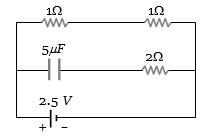
- 1A capacitor of capacitance $5\,\mu F$ is connected as shown in the figure. The internal resistance of the cell is $0.5\,\Omega $. The amount of charge on the capacitor plate is......$\mu C$View Solution
- 2Three capacitors of capacitance $3\,\mu \,F$ are connected in a circuit. Then their maximum and minimum capacitances will beView Solution
- 3Choose the $CORRECT$ optionView Solution
- 4View SolutionState which of the following is correct
- 5A parallel plate capacitor with area $200\,cm^2$ and separation between the plates $1.5\,cm$, is connected across a battery of $emf$ $V$. If the force of attraction between the plates is $25\times10^{-6}\,N$, the value of $V$ is approximately........$V$ $\left( {{\varepsilon _0} = 8.85 \times {{10}^{ - 12}}\,\frac{{{C^2}}}{{N{m^2}}}} \right)$View Solution
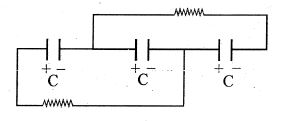
- 6Three identical capacitors (initial charge zero) are connected in series combination and charged through a battery of emf $E$ . After removing battery two resistances are connected to these capacitors as given. The heat dissipated in each of the resistance isView Solution
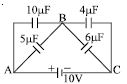
- 7In the circuit shown in figure, four capacitors are connected to a battery. The maximum energy is stored in the capacitor of.....$\mu F$View Solution
- 8A conducting sphere of radius $r$ has a charge. ThenView Solution
- 9The electric potential at a point on the axis of an electric dipole depends on the distance $r$ of the point from the dipole asView Solution
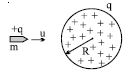
- 10A bullet of mass $m$ and charge $q$ is fired towards a solid uniformly charged sphere of radius $R$ and total charge $+ q$. If it strikes the surface of sphere with speed $u$, find the minimum speed $u$ so that it can penetrate through the sphere. (Neglect all resistance forces or friction acting on bullet except electrostatic forces)View Solution