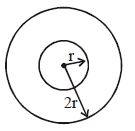
If the potential of the inner shell is $10\,V$ and that of the outer shell is $5\,V$, then potential at the centre will be....$V$
Easy
Download our app for free and get started
${{\rm{V}}_{{\rm{in}}}} = \frac{{{\rm{k}}{{\rm{Q}}_1}}}{{\rm{a}}} + \frac{{{\rm{k}}{{\rm{Q}}_2}}}{{2{\rm{a}}}} = 10\,{\rm{V}}$ (this will be constant for region from center to inner sphere surface)
$\mathrm{V}_{\mathrm{out}}=\frac{\mathrm{k} \mathrm{Q}_{1}}{2 \mathrm{a}}+\frac{\mathrm{kQ}_{2}}{2 \mathrm{a}}=5 \mathrm{\,V}$

Download our appand get started for free
Experience the future of education. Simply download our apps or reach out to us for more information. Let's shape the future of learning together!No signup needed.*
Similar Questions
- 1A particle $A$ has charge $ + q$ and a particle $B$ has charge $ + \,4q$ with each of them having the same mass $m$. When allowed to fall from rest through the same electric potential difference, the ratio of their speed $\frac{{{v_A}}}{{{v_B}}}$ will becomeView Solution
- 2View SolutionThe vehicles carrying inflammable fluids usually have metallic chains touching the ground:
- 3A parallel-plate capacitor is connected to a resistanceless circuit with a battery until the capacitor is fully charged. The battery is then disconnected from the circuit and the plates of the capacitor are moved to half of their original separation using insulated gloves. Let $V_{new}$ be the potential difference across the capacitor plates when the plates have moved. Let $V_{old}$ be the potential difference across the capacitor plates when they were connected to the battery $\frac{V_{new}}{V_{old}}=$......View Solution
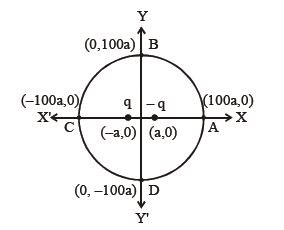
- 4An electric dipole is placed on the $x-$axis as shown in the figure. Consider a spherical closed surface around it. ThenView Solution
- 5The electric potential at a point $(x,\;y)$ in the $x - y$ plane is given by $V = - kxy$. The field intensity at a distance $r$ from the origin varies asView Solution
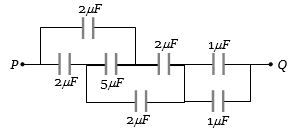
- 6The effective capacitance between the points $P$ and $Q$ of the arrangement shown in the figure is......$\mu F$View Solution
- 7A parallel plate capacitor Air filled with a dielectric whose dielectric constant varies with applied voltage as $K = V$. An identical capacitor $B$ of capacitance $C_0$ with air as dielectric is connected to voltage source $V_0 = 30\,V$ and then connected to the first capacitor after disconnecting the voltage source. The charge and voltage on capacitor.View Solution
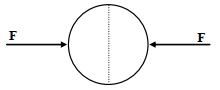
- 8A uniformly charged thin spherical shell of radius $\mathrm{R}$ carries uniform surface charge density of $\sigma$ per unit area. It is made of two hemispherical shells, held together by pressing them with force $\mathrm{F}$ (see figure). $\mathrm{F}$ is proportional toView Solution
- 9View SolutionIn the transient shown the time constant of the circuit is :
- 10The capacity of a parallel plate condenser is $5\,\mu F$. When a glass plate is placed between the plates of the conductor, its potential becomes $1/8^{th}$ of the original value. The value of dielectric constant will beView Solution