The capacity of a parallel plate condenser is $5\,\mu F$. When a glass plate is placed between the plates of the conductor, its potential becomes $1/8^{th}$ of the original value. The value of dielectric constant will be
Easy
Download our app for free and get started
(c) $V' = \frac{V}{8}$ $==>$ $\frac{V}{K} = \frac{V}{8}$ $==>$ $K = 8$

Download our appand get started for free
Experience the future of education. Simply download our apps or reach out to us for more information. Let's shape the future of learning together!No signup needed.*
Similar Questions
- 1Find the charge on capacitor $C_3$View Solution
Given, that $C_1=C_2=C$ and $C_3=C_4=3 C$.
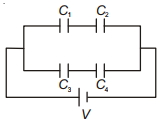
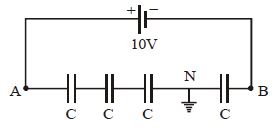
- 2Four identical capacitors are connected in series with a $10\,V$ battery as shown. The point $N$ is earthed. The potentials of points $A$ and $B$ areView Solution
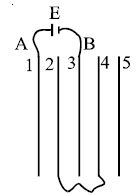
- 3Separation between the plates of a parallel plate capacitor is $d$ and the area of each plate is $A$. When a slab of material of dielectric constant $k$ and thickness $t(t < d)$ is introduced between the plates, its capacitance becomesView Solution
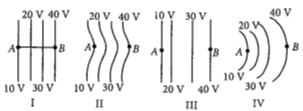
- 4The diagrams below show regions of equipotentials.A positive charge is moved from $A$ to $B$ in each diagram.View Solution
- 5A charged particle of charge $Q $ is held fixed and another charged particle of mass $m$ and charge $q$ (of the same sign) is released from a distance $r.$ The impulse of the force exerted by the external agent on the fixed charge by the time distance between $Q$ and $q$ becomes $2r$ isView Solution
- 6Two metal pieces having a potential difference of $800 \;V$ are $0.02\; m$ apart horizontally. A particle of mass $1.96 \times 10^{-15} \;kg$ is suspended in equilibrium between the plates. If $e$ is the elementary charge, then charge on the particle isView Solution
- 7Two hollow conducting spheres of radii $R_{1}$ and $R_{2}$ $\left(R_{1}>>R_{2}\right)$ have equal charges. The potential would be:View Solution
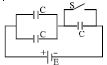
- 8In the circuit shown, each capacitor has a capacitance $C$. The emf of the cell is $E$. If the switch $S$ is closedView Solution
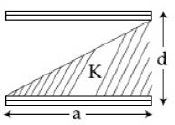
- 9A parallel plate capacitor is made of two square plates of side $a$, separated by a distance $d\,(d < < a)$. The lower triangular portion is filled with a dielectric of dielectric constant $K$, as shown in the figure. Capacitance of this capacitor isView Solution
- 10Five conducting parallel plates having area $A$ and separation between them $d$, are placed as shown in the figure. Plate number $2$ and $4$ are connected wire and between point $A$ and $B$, a cell of emf $E$ is connected. The charge flown through the cell isView Solution