If the temperature increases, the modulus of elasticity
Easy


Download our appand get started for free
Experience the future of education. Simply download our apps or reach out to us for more information. Let's shape the future of learning together!No signup needed.*
Similar Questions
- 1Consider a thin square plate floating on a viscous liquid in a large tank. The height $h$ of the liquid in the tank is much less than the width of the tank. The floating plate is pulled horizontally with a constant velocity $u_0$. Which of the following statements is (are) true?View Solution
$(A)$ The resistive force of liquid on the plate is inversely proportional to $h$
$(B)$ The resistive force of liquid on the plate is independent of the area of the plate
$(C)$ The tangential (shear) stress on the floor of the tank increases with $u _0$
$(D)$ The tangential (shear) stress on the plate varies linearly with the viscosity $\eta$ of the liquid
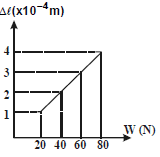
- 2The adjacent graph shows the extension $(\Delta l)$ of a wire of length $1\, m$ suspended from the top of a roof at one end and with a load $W$ connected to the other end. If the cross-sectional area of the wire is $10^{-6}\, m^2$, calculate the Young’s modulus of the material of the wire.View Solution
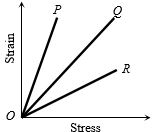
- 3The strain-stress curves of three wires of different materials are shown in the figure. $P, Q$ and $R$ are the elastic limits of the wires. The figure shows thatView Solution
- 4View SolutionThe force constant of a wire does not depend on
- 5If $x$ longitudinal strain is produced in a wire of Young's modulus $y,$ then energy stored in the material of the wire per unit volume isView Solution
- 6The temperature of a wire of length $1$ metre and area of cross-section $1\,c{m^2}$ is increased from $0°C$ to $100°C$. If the rod is not allowed to increase in length, the force required will be $(\alpha = {10^{ - 5}}/^\circ C$ and $Y = {10^{11}}\,N/{m^2})$View Solution
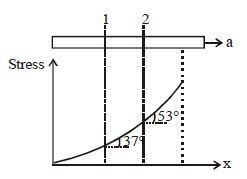
- 7Rod of constant cross-section moves towards right with constant acceleration. Graph of stress and distance from left end is given as in figure. If density of material of rod at cross section $1$ is $9$ $\frac{{gm}}{{c{m^3}}}$ . Find density at cross section $2$.View Solution
.......... $\mathrm{gm} / \mathrm{cm}^{3}$
- 8A steel rod of length $1\,m$ and cross sectional area $10^{-4}\,m ^2$ is heated from $0^{\circ}\,C$ to $200^{\circ}\,C$ without being allowed to extend or bend. The compressive tension produced in the rod is $........\times 10^4\,N$ (Given Young's modulus of steel $=2 \times 10^{11}\,Nm ^{-2}$, coefficient of linear expansion $=10^{-5}\, K ^{-1}$.View Solution
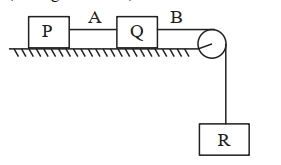
- 9Each of three blocks $P$, $Q$ and $R$ shown in figure has a mass of $3 \mathrm{~kg}$. Each of the wire $A$ and $B$ has cross-sectional area $0.005 \mathrm{~cm}^2$ and Young's modulus $2 \times 10^{11} \mathrm{~N} \mathrm{~m}^{-2}$. Neglecting friction, the longitudinal strain on wire $B$ is____________ $\times 10^{-4}$. $\left(\right.$ Take $\mathrm{g}=10 \mathrm{~m} / \mathrm{s}^2$ )View Solution
- 10A steel wire of lm long and $1\,m{m^2}$ cross section area is hang from rigid end. When weight of $1\,kg$ is hung from it then change in length will be given ..... $mm$ $(Y = 2 \times {10^{11}}N/{m^2})$View Solution