MCQ
If $\vec{A}+\vec{B}=\vec{C}$ and $A = B = C$, then what should be the angle between $\vec{A}$ and $\vec{B}$ ?
  • A
    $0$
  • B
    $\frac{\pi}{3}$
  • C
    $\frac{2 \pi}{3}$
  • D
    $\pi$

Answer

C. $\frac{2 \pi}{3}$
Explanation:
$
\begin{array}{l}
C=\left[A^2+B^2+2 AB \cos \frac{2 \pi}{3}\right]^{1 / 2} \\
=\left[A^2+B^2+2 A^2\left(-\frac{1}{2}\right)\right]^{1 / 2}=A=B
\end{array}
$

Need a full question paper?

Generate a complete, print-ready paper with questions like this in minutes — across 16+ boards, with answer keys.
Start Generating Free

Similar questions

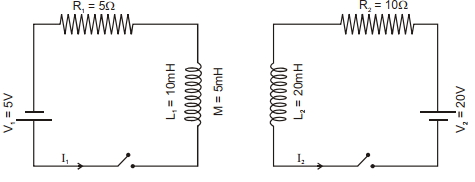
The inductors of two $L R$ circuits are placed next to each other, as shown in the figure. The values of the self-inductance of the inductors, resistances, mutual-inductance and applied voltages are specified in the given circuit. After both the switches are closed simultaneously, the total work done by the batteries against the induced $E M F$ in the inductors by the time the currents reach their steady state values is. . . . . $mJ$
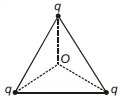
Three isolated equal charges are placed at the three comers of an equilateral triangle as shown in figure. The statement which is true for net electric potential $V$ and net electric field intensity $E$ at the centre of the triangle is
A block of mass $M$ is hanging over a smooth and light pulley through a light string. The other end of the string is pulled by a constant force $F$. The kinetic energy of the block increases by $20\,J$ in $1\, s$.
At the first minimum adjacent to the central maximum of a single-slit diffraction pattern, the phase difference between the Huygen's wavelet from the edge of the slit and the wavelet from the midpoint of the slit is 
Stars are not visible in the day time because
A child weighing $25 \,kg$ slides down a rope hanging from a branch of a tall tree. If the force of friction acting against him is $200 \,N$, the acceleration of child is ........... $m / s^2$ $\left(g=10 \,m / s ^2\right)$
A uniform vertical electric field $E$ is established in the space between two large parallel  plates. A small conducting sphere of mass $m$ is suspended in the field from a string of  length $L$. If the sphere is given $a + q$ charge and the lower plate is charged positvely, the period of oscillation of this pendulum is :- 
A boy of mass $4\, kg$ is standing on a piece of wood having mass $5 \,kg$. If the coefficient of friction between the wood and the floor is $0.5,$ the maximum force that the boy can exert on the rope so that the piece of wood does not move from its place is ......$N.$(Round off to the Nearest Integer) [Take $g=10 \,ms ^{-2}$ ]
In an experiment to study standing waves, you use a string whose mass per length is $μ$ = $(1.0 ± 0.1) × 10^{-4}\ kg/m$ . You look at the fundamental mode, whose frequency $f$ is related to the length $L$ and tension $T$ of the string by the following equation $L$ = $\frac{1}{{2f}}\sqrt {\frac{T}{\mu }} $ You make a plot with $L$ on the $y-$ axis and $\sqrt T$ on the $x-$ axis, and find that the best fitting line is $y$ = $(8.0 ± 0.3) × 10^{-3}x + (0.2 ± 0.04)$ in $SI\ units$ . What is the value of the frequency of the wave (including the error)? Express your result in $SI\ unit\ (Hz)$
An electron of a stationary hydrogen atom passes from the fifth energy level to the ground level. The velocity that the atom acquired as a result of photon emission will be