Question
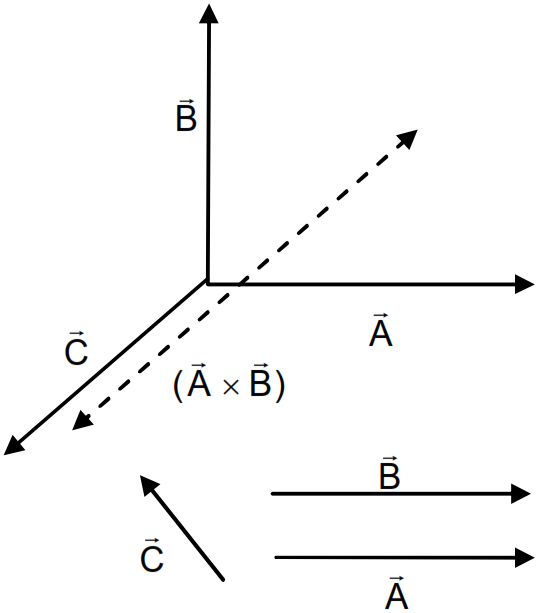
If $\vec{\text{A}},\vec{\text{B}},\vec{\text{C}}$ are mutually perpendicular, show that $\vec{\text{C}}\times(\vec{\text{A}}\times\vec{\text{B}})=0.$ Is the converse true?

Answer

Given that $\vec{\text{A}},\vec{\text{B}}$ and $\vec{\text{C}}$ are mutually perpendicular$\vec{\text{A}}\times\vec{\text{B}}$ is a vector which direction is perpendicular to the plane containing $\vec{\text{A}}$ and $\vec{\text{B}}.$

Also $\vec{\text{C}}$ is perpendicular to $\vec{\text{A}}$ and $\vec{\text{B}}$

$\therefore$ Angle between $\vec{\text{C}}$ and $\vec{\text{A}}\times\vec{\text{B}}$ is $0^{\circ}$ or $180^{\circ}$

So, $\vec{\text{C}}\times(\vec{\text{A}}\times\vec{\text{B}})=0$

The converse is not true.

For example, if two of the vector are parallel, then also

$\vec{\text{C}}\times(\vec{\text{A}}\times\vec{\text{B}})=0$

So, they need not be mutually perpendicular.
Need a full question paper?

Generate a complete, print-ready paper with questions like this in minutes — across 16+ boards, with answer keys.

Start Generating Free

Similar questions

Differentiate between streamline flow and turbulent flow.
State and prove the principle of law of conservation of linear momentum.
A child running a temperature of $101^{\circ} F$ is given an antipyrin (i.e. a medicine that lowers fever) which causes an increase in the rate of evaporation of sweat from his body. If the fever is brought down to $98^{\circ} F$ in 20 min , what is the average rate of extra evaporation caused by the drug. Assume the evaporation mechanism to be the only way by which heat is lost. The mass of the child is 30 kg . The specific heat of human body is approximately the same as that of water and latent heat of evaporation of water at that temperature is about 580 cal $g ^{-1}$.
Briefly explain the formation of trade wind.
Why the molecular motion of the molecules ceases at zero kelvin?
A particle executes the motion described by $\text{x}(\text{t})=\text{x}_0(1-\text{e}^{-\gamma\text{t}});\text{t}\ge0,\text{x}_0>0.$
Find maximum and minimum values of x(t), v(t), a(t). Show that x(t) and a(t) increase with time and v(t) decreases with time.
Einstein’s mass - energy relation emerging out of his famous theory of relativity relates mass (m) to energy (E) as E = mc2, where c is speed of light in vacuum. At the nuclear level, the magnitudes of energy are very small. The energy at nuclear level is usually measured in MeV, where 1MeV = 1.6 × 10⁻¹³J; the masses are measured in unified atomic mass unit (u) where 1u = 1.67 × 10⁻²⁷kg.
  1. Show that the energy equivalent of 1u is 931.5MeV.
  2. A student writes the relation as 1u = 931.5MeV. The teacher points out that the relation is dimensionally incorrect. Write the correct relation.
A planet of mass m moves along an ellipse around the sun so that its maximum and minimum distances from the sun are r1 and r2. Find the angular momentum of the planet relative to centre of sun. (Mass of sun = M)
The mass of a spaceship is 1000kg. It is to be launched from the earth's surface out into free space. The value of g and R (radius of earth) are 10m/ s2 and 6400km, respectively.
What is the required energy for this work done?
A solid sphere rolling on a rough horizontal surface with a linear speed v collides elastically with a fixed, smooth, vertical wall. Find the speed of the sphere after it has started pure rolling in the backward direction.