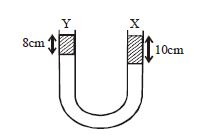
A liquid $X$ of density $3.36\ g/cm^3$ is poured in a $U-$ tube, which contains $Hg$. Another liquid $Y$ is poured in left arm with height $8\ cm$, upper levels of $X$ and $Y$ are same. What is density of $Y$ .......... $g/cc$
Medium
Download our app for free and get started
As shown in figure, in the two arms of a tube pressure remains same on surface $pp'.$ Hence,
$8 \times \rho_{y} \times g+2 \times \rho_{H g} \times g=10 \times \rho_{x} \times g$
$\therefore 8 \rho_{y}+2 \times 13.6=10 \times 3.36$
or $\rho_{y}=\frac{33.6-27.2}{8}=0.8 \mathrm{g} / \mathrm{cc}$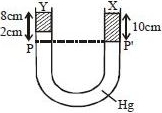

Download our appand get started for free
Experience the future of education. Simply download our apps or reach out to us for more information. Let's shape the future of learning together!No signup needed.*
Similar Questions
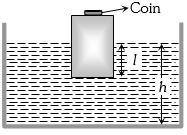
- 1A wooden block, with a coin placed on its top, floats in water as shown in fig. the distance $l $ and $h$ are shown there. After some time the coin falls into the water. ThenView Solution
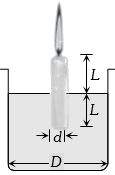
- 2A candle of diameter $ d$ is floating on a liquid in a cylindrical container of diameter $D $ $(D>>d)$ as shown in figure. If it is burning at the rate of $2$ cm/hour then the top of the candle willView Solution
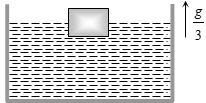
- 3A cubical block is floating in a liquid with half of its volume immersed in the liquid. When the whole system accelerates upwards with acceleration of $g/3,$ the fraction of volume immersed in the liquid will beView Solution
- 4$Assertion :$ A bubble comes from the bottom of a lake to the top.View Solution
$Reason :$ Its radius increases. - 5A square plate of $0.1 \;m$ side moves parallel to a second plate with a velocity of $ 0.1\; m/s$, both plates being immersed in water. If the viscous force is $0.002\; N$ and the coefficient of viscosity is $ 0.01 $ poise, distance between the plates in $m$ isView Solution
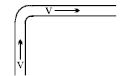
- 6A fire hydrant delivers water of density $\rho $ at a volume rate $L$. The water travels vertically upward through the hydrant and then does $90^o$ turn to emerge horizontally at speed $V$. The pipe and nozzle have uniform cross-section throughout. The force exerted by the water on the corner of the hydrant isView Solution
- 7Water is pumped from a depth of $10 $ $m$ and delivered through a pipe of cross section $10^{-2}$ $m^2$. If it is needed to deliver a volume of $10^{-1} $ $m^3$ per second the power required will be ........ $kW$View Solution
- 8The area of cross-section of a large tank is $0.5 \; m ^{2}$. It has a narrow opening near the bottom having area of cross-section $1 \; cm ^{2}$. A load of $25 \; kg$ is applied on the water at the top in the tank. Neglecting the speed of water in the tank, the velocity of the water, coming out of the opening at the time when the height of water level in the tank is $40 \; cm$ above the bottom, will be $\dots \; cms ^{-1}$. $\left[\right.$ Take $\left.g =10 \; ms ^{-2}\right]$View Solution
- 9An inverted tube barometer is kept on a lift with a moving downward with a deceleration $\alpha $ . The density of mercury is $\rho$ and acceleration due to gravity is $g$ . If the atmospheric pressure be $P_0$ thenView Solution
- 10A piece of gold weighs $10 \,g$ in air and $9 \,g$ in water. What is the volume of cavity is $...... cc ($Density of gold $=19.3 \,g \ cm ^{-3} )$View Solution