MCQ
If $y$ represents pressure and $x$ represents velocity gradient, then the dimensions of $\frac{d^2 y}{d x^2}$ are
  • A
    $\left[ ML ^{-1} T ^{-2}\right]$
  • B
    $\left[ M ^2 L ^{-2} T ^{-2}\right]$
  • $\left[ ML ^{-1} T ^0\right]$
  • D
    $\left[ M ^2 L ^{-2} T ^{-4}\right]$

Answer

Correct option: C.
$\left[ ML ^{-1} T ^0\right]$
c
(c)

$\frac{d^2 y}{d x^2}$ will have dimensions of $\frac{y}{x^2}$

$y \rightarrow$ pressure, $x \rightarrow$ velocity gradient

$x \rightarrow \frac{V}{L} \Rightarrow \frac{ LT ^{-1}}{ L } \Rightarrow T ^{-1}$

$\frac{y}{x^2}=\frac{ ML ^{-1} T ^{-2}}{ T ^{-2}} \Rightarrow\left[ ML ^{-1}\right]$

Need a full question paper?

Generate a complete, print-ready paper with questions like this in minutes — across 16+ boards, with answer keys.

Start Generating Free

Similar questions

Two identical balls $P$ and $Q$ moving in the $x-y$ plane collide at the origin $(x=0,y=0)$ of the coordinate system. Their velocity components just before the moment of impact were, for ball $P$, $v_x=6\ m/s$, $v_y=0$; for ball $Q$, $v_x=-5\ m/s$, $v_y=2\ m/s$. As a result of the collision, the ball $P$ comes to rest. The velocity components of the ball $Q$ just after collision will be
If a body looses half of its velocity on penetrating $3 \,cm$ in a wooden block, then how much will it penetrate more before coming to rest ........... $cm$
Efficiency of engine is $\eta_1$ at $T_1 = 200^\circ C$ and $T_2 = 0^\circ C$ and $\eta_2$ at $T_1 = 0^\circ C$ and $T_2 = 200^\circ K.$ Find the ratio of $\frac{\eta_1}{\eta_2}.$
A horizontal pipe line carries water in a streamline flow.At a point along the tube where the cross-sectional area is $10^{-2}$ $m^2$, the water velocity is $2$ $ms^{^{-1}}$ and the pressure is $8000 $ $Pa$. The pressure of water at another point where the cross-sectional area is $0.5$ $\times 10^{-2}$ $m^2$ is ........  $Pa$
Two damped spring-mass oscillating systems have identical spring constants and decay times. However, system $A's$ mass $m_A$ is twice system $B's$ mass $m_B$ . How do their damping constants, $b$ , compare ?
The earth is an approximate sphere. If the interior contained matter which is not of the same density everywhere, then on the surface of the earth, the acceleration due to gravity.
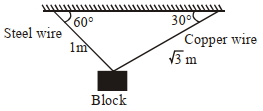
A block of weight $100 N$ is suspended by copper and steel wires of same cross sectional area $0.5 cm ^2$ and, length $\sqrt{3} m$ and $1 m$, respectively. Their other ends are fixed on a ceiling as shown in figure. The angles subtended by copper and steel wires with ceiling are $30^{\circ}$ and $60^{\circ}$, respectively. If elongation in copper wire is $\left(\Delta \ell_{ C }\right)$ and elongation in steel wire is $\left(\Delta \ell_{ s }\right)$, then the ratio $\frac{\Delta \ell_{ C }}{\Delta \ell_{ S }}$ is. . . . . .

[Young's modulus for copper and steel are $1 \times 10^{11} N / m ^2$ and $2 \times 10^{11} N / m ^2$ respectively]

Obtain the dimensional equation for universal gas constant.
A rope is wound around a hollow cylinder of mass $3\, kg$ and radius $40\, cm.$ ........ $rad/sec^2$ is the angular acceleration of the cylinder if the rope is pulled with a force of $30\, N\,?$
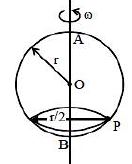
A smooth wire of length $2\pi r$ is bent into a circle and kept in a vertical plane. A bead can slide smoothly on the wire. When the circle is rotating with angular speed $\omega$ about the vertical diameter $AB$, as shown in figure, the bead is at rest with respect to the circular ring at position $P$ as shown. Then the value of $\omega^2$ is equal to