In a closed organ pipe the frequency of fundamental note is $50 Hz$. The note of which of the following frequencies will not be emitted by it .... $Hz$
Easy
Download our app for free and get started
(b) Only odd harmonics are present.

Download our appand get started for free
Experience the future of education. Simply download our apps or reach out to us for more information. Let's shape the future of learning together!No signup needed.*
Similar Questions
- 1Two waves are approaching each other with a velocity of $20 m/s$ and frequency $n$. The distance between two consecutive nodes isView Solution
- 2View SolutionThe walls of the halls built for music concerts should
- 3An organ pipe $40\,cm$ long is open at both ends. The speed of sound in air is $360\,ms ^{-1}$. The frequency of the second harmonic is $...........\,Hz$.View Solution
- 4View SolutionThe minimum audible wavelength at room temperature is about
- 5An organ pipe $P_1$ closed at one end vibrating in its first overtone. Another pipe $P_2$ open at both ends is vibrating in its third overtone. They are in a resonance with a given tuning fork. The ratio of the length of $P_1$ to that of $P_2$ is :View Solution
- 6A source of sound of frequency $500 Hz$ is moving towards an observer with velocity $30 m/s$. The speed of sound is $330 m/s$. the frequency heard by the observer will be .... $Hz$View Solution
- 7View SolutionThe minimum intensity of sound is zero at a point due to two sources of nearly equal frequencies, when
- 8When a wave travels in a medium, the particle displacements are given by $y = a\, sin\, 2\pi\, (bt -cx)$ where $a, b,$ and $c$ are constants. The maximum particle velocity will be twice the wave velocity ifView Solution
- 9View SolutionA sound is produced by plucking a string in a musical instrument, then
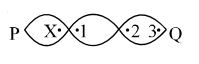
- 10Figure, shows a stationary wave between two fixed points $P$ and $Q$. Which point$(s)$ of $1, 2$ and $3$ are in phase with the point $X?$View Solution