MCQ
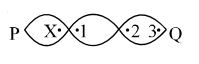
Figure, shows a stationary wave between two fixed points $P$ and $Q$. Which point$(s)$ of $1, 2$ and $3$ are in phase with the point $X?$
- A$1, 2$ and $3$
- B$1$ and $2$ only
- C$2$ and $3$ only
- ✓$3$ only
Generate a complete, print-ready paper with questions like this in minutes — across 16+ boards, with answer keys.
The logic symbols for $OR, NOT$ and $NAND$ gates are respectively 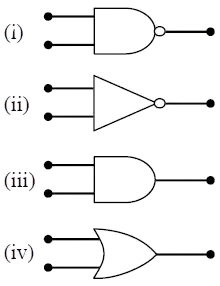
$A$. In a plane electromagnetic wave electric field and magnetic field must be perpendicular to each other and direction of propagation of wave should be along electric field or magnetic field.
$B.$ The energy in electromagnetic wave is divided equally between electric and magnetic fields.
$C.$ Both electric field and magnetic field are parallel to each other and perpendicular to the direction of propagation of wave.
$D.$ The electric field, magnetic field and direction of propagation of wave must be perpendicular to each other.
$E.$ The ratio of amplitude of magnetic field to the amplitude of electric field is equal to speed of light.
Choose the most appropriate answer from the options given below: